That Look Your Dog Gives You Is Real Science: 12 Simple Ways to Bond With Your Dog, Starting Tonight

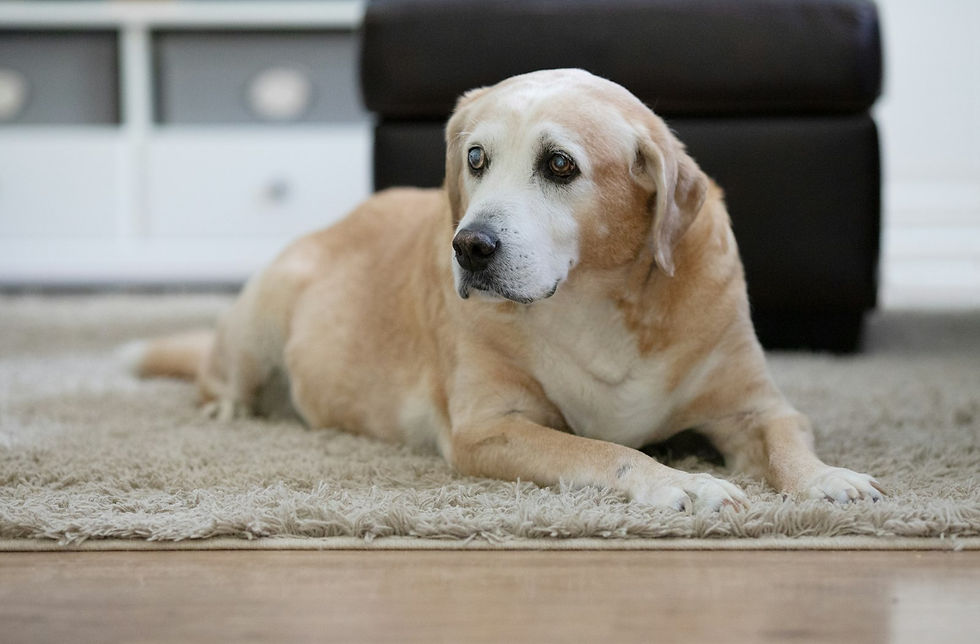
Tonight, when your dog lifts those eyes to yours, something invisible will pass between you.
It isn't your imagination. It is chemistry, measured and published in some of the world's most respected science journals, and it has bound our two species together since long before the first field of wheat.
If you have ever wondered whether your dog truly loves you, or how to bond with your dog more deeply, stay with me. What science has learned about the human-dog bond is more beautiful than most dog lovers dare to hope.
You will meet a puppy nursed through a deadly illness 14,000 years ago, a dog who walked some 2,500 miles to get home, and a three-second test that tells you whether your dog really wants to be petted. Then come 12 simple ways to deepen your bond.
The Look That Changes You Both
In 2015, researchers led by Miho Nagasawa and Takefumi Kikusui of Azabu University in Japan published a remarkable study in Science. They asked 30 owners to spend half an hour with their dogs, measuring oxytocin, the hormone that helps bond a mother to her baby, in dogs and owners before and after.
The dogs that gazed longest at their owners triggered the biggest rise in their owners' oxytocin.
The owners who looked back, stroked and talked to their dogs most had dogs whose oxytocin rose most.
Pairs that shared only quick glances showed little change.
Then came the twist. Hand-raised wolves rarely held eye contact with the people who raised them, and their gaze did nothing to those people's oxytocin.
In a second experiment, female dogs given a nasal spray of oxytocin spent more time gazing at their owners, and the owners' oxytocin rose in turn. The hormone was flowing in a circle, from dog to human and back again.
The researchers called it an "oxytocin-gaze positive loop." In a commentary alongside the study, dog scientists Evan MacLean and Brian Hare chose a title every dog lover will understand: "Dogs hijack the human bonding pathway."
So when your dog looks at you that way, your body answers. And your dog's body answers yours.

Those Puppy-Dog Eyes Were Made for You
You know the look: inner eyebrows lifted, eyes wide and soft, and suddenly you are sharing your sandwich.
In 2019, a team led by psychologist Juliane Kaminski of the University of Portsmouth reported in the journal PNAS that this look has its own muscle. Dissections showed that dogs have a small muscle that raises the inner eyebrow, the levator anguli oculi medialis. In wolves it was barely there, little more than a few stray fibres.
When dogs and wolves spent two minutes with a person, the dogs raised their inner brows more often and more intensely. The movement makes the eyes look bigger and more childlike, a little like a sad human face. Kaminski said it seems "to elicit a strong desire in humans to look after them."
That desire is real. A 2013 study in PLOS ONE filmed 27 dogs in UK rescue shelters, and the dogs that raised their inner brows more often found new homes faster. Tail wagging did not help.
Picture this: an Ice Age campfire, and at the edge of the light, a wolf-like animal that lifts its brows when a human looks its way. Thousands of generations later, that same expression is gazing up at you from beside the couch.

Your Dog Hears Your Words and Your Heart
When you say "good girl," does your dog understand the words, or just your happy voice? Both.
In a 2016 study in Science, Attila Andics and colleagues at Eötvös Loránd University in Budapest scanned the brains of 13 awake dogs, trained to lie still, as their trainer spoke. The left side of the dogs' brains processed the meaning of praise words. The right side processed tone of voice. And the brain's reward centre responded strongly only when praise words came in a praising tone.
That sing-song voice you use without thinking matters too. A 2018 University of York study in Animal Cognition found that adult dogs paid more attention to, and chose to spend time with, a person using high-pitched "dog-speak" with dog-relevant words such as "you're a good dog." Mix up the tone and the words, and the preference vanished.
This gift seems built in. A 2021 study in Current Biology tested 375 puppies just eight weeks old. Many already followed a person's pointing finger to a hidden treat, and genes explained more than 40 percent of the differences between them.
Dogs, it seems, arrive in the world ready to understand us. And they watch whether we are paying attention. A 2017 study in Scientific Reports found that dogs made more facial expressions when a person was looking at them than when the person turned away. The sight of food made no such difference. Those expressions, the researchers suggested, may be a way of talking to us.
Your Dog's Brain Lights Up for You
Does your dog love you, or just the person who fills the food bowl?
Neuroscientist Gregory Berns of Emory University scanned the brains of awake dogs to find out. In one study, 12 dogs sniffed five scents. The brain's reward-linked caudate nucleus responded most strongly to the scent of a familiar person who was not even in the room. Dogs' brains, Berns said, hold "mental representations of us that persist when we're not there."
In a 2016 study in Social Cognitive and Affective Neuroscience, his team compared praise with food. In 13 of 15 dogs, the brain's reward response to their owner's praise was about equal to, or greater than, the response to food.
Tears of joy are real
In 2022, Kikusui's team reported in Current Biology that 18 dogs, after five to seven hours apart from their owners, produced noticeably more tears in the first five minutes of reunion. Meeting another person did not have the same effect, and oxytocin drops in the eyes also increased tears.
"We found that dogs shed tears associated with positive emotions," Kikusui said. So if your dog's eyes look glossy when you walk through the door, you may be seeing exactly what it looks like.
You Are Your Dog's Safe Place
A toddler explores more boldly with a parent nearby. Psychologists call it a "secure base," and dogs do it too.
In a 2013 study of 46 dogs in PLOS ONE, dogs worked longer at food-puzzle toys when their owner was in the room, whether the owner encouraged them or sat in silence. A stranger in the owner's place made no difference. It wasn't cheerleading that helped. It was you.
Your dog also notices when you hurt. In a 2018 Johns Hopkins study in Learning & Behavior, 34 owners sat behind a see-through door and either hummed or cried. Dogs who pushed through to a crying owner did so about three times faster than dogs whose owners were humming.
And your stress travels down the leash. A 2019 Swedish study of 58 dogs found their long-term stress hormone levels tracked their owners'. When you slow down and breathe, you care for two hearts at once.
🐾 A Gentle Reminder It is never too late. In a 2001 study of 60 adult shelter dogs, dogs handled by a new person for just three 10-minute sessions began treating that person as an attachment figure, seeking contact with them. Every dog is different, and some need far longer. But if you have adopted an older or anxious dog, take heart: love can grow at any age. |
What Your Dog Gives Back: The Health Gifts
The human-dog bond doesn't only feel good. It may help keep you alive.
In 2019, a review led by Dr Caroline Kramer in the American Heart Association journal Circulation: Cardiovascular Quality and Outcomes pooled 10 studies of more than 3.8 million people. Dog owners had a 24% lower risk of dying from any cause and a 31% lower risk of dying from cardiovascular causes. Among people who had already had a heart attack, the risk of death was 65% lower.
A Swedish study in the same issue followed nearly 182,000 heart attack patients and nearly 155,000 stroke patients. Dog owners who lived alone had a 33% lower risk of death after a heart attack, and a 27% lower risk after a stroke, than people living alone without a dog.
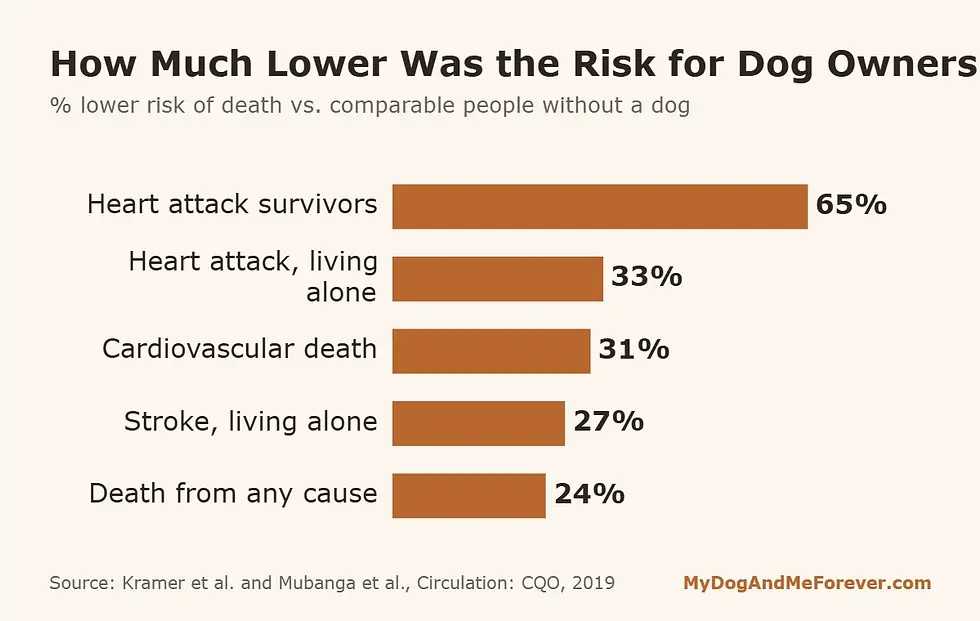
These studies show a link, not proof. People who choose dogs may already be healthier. Kramer put it modestly: "Our findings suggest that having a dog is associated with longer life."
Still, some everyday reasons are well documented:
You move more. In a 2017 UK study in BMC Public Health, dog owners aged 65 and over walked about 20 minutes more a day, and took 2,760 more steps a day, than similar people without dogs.
You hit your exercise goals. A 2019 University of Liverpool study estimated that dog owners are about four times as likely to meet recommended physical activity guidelines.
Your stress hormones fall. Washington State University researchers found that 249 students who spent 10 minutes petting dogs and cats had significantly lower cortisol afterwards. "Just 10 minutes can have a significant impact," said lead author Patricia Pendry.
A Love Story at Least 15,000 Years Old
The American Veterinary Medical Association defines the human-animal bond as "a mutually beneficial relationship between people and animals." With dogs, it is older than farming, older than writing, older than any city.
Exactly when it began is still debated. A 2021 study in PNAS proposed that dogs were first domesticated in Siberia more than 23,000 years ago. In 2026, scientists writing in Nature reported the oldest dog DNA yet found, about 15,800 years old, from Pınarbaşı in Türkiye, where people likely fed their dogs fish and deliberately buried them.

The puppy who was loved through illness
In 1914, quarry workers near Bonn, Germany, uncovered a 14,000-year-old grave holding a man, a woman and two dogs. It is the oldest known grave where people and dogs were buried together.
Leiden University veterinarian Luc Janssens later re-examined the younger dog's teeth. The puppy, only six or seven months old when it died, had suffered from canine distemper, living through two or three serious bouts of illness lasting weeks each. It would almost certainly have needed warmth, cleaning, water and food from people to survive, and a puppy that sick could do no work for them.
Someone, 14,000 years ago, simply cared. Janssens said the find suggests "a unique relationship of care between humans and dogs."
Hachikō: the dog who waited
Hachikō, an Akita born in November 1923, met his owner, Professor Hidesaburō Ueno of Tokyo Imperial University, at Shibuya Station each day. In May 1925, the professor died suddenly. He never came home.
Hachikō kept returning to the station for almost ten years, looked after by various people. In 1932, a newspaper article told his story, and the faithful dog became famous across Japan. In April 1934, a bronze statue of him was unveiled at the station, with Hachikō himself present. He died on March 8, 1935. Melted down in the Second World War, the statue was replaced in 1948 by one from the sculptor's son.
In March 2015, around the 80th anniversary of his death, the University of Tokyo unveiled a statue of Hachikō joyfully greeting the professor: the reunion he waited for and never had. Today, some of Hachikō's remains rest beside his beloved professor at Aoyama Cemetery in Tokyo.

Bobbie: the dog who walked home
In August 1923, Frank and Elizabeth Brazier of Silverton, Oregon, lost their two-year-old collie mix, Bobbie, at a petrol station in Wolcott, Indiana, when local dogs chased him off. After days of searching, they had to drive home without him.
In February 1924, six months later, Bobbie walked back into Silverton: scrawny, matted, his feet "worn to the bone," as the Oregon Encyclopedia records. Estimates of his winter journey run from about 2,500 to 2,800 miles. Humane society officials later gathered accounts from people along the way who had fed or sheltered him. Bobbie died in 1927, and the film star Rin Tin Tin later laid a wreath at his grave.
Silverton has never forgotten him. A 70-foot mural of his journey was completed in 2004, and the town's children's pet parade, first held in 1932, was first led by Bobbie's son, Pal.
How to Read Your Dog's Body Language
To bond with your dog deeply, you need to understand them, and your dog talks to you all day, mostly with their body. The ASPCA and the American Kennel Club describe these key signals. Read them together, never one alone.
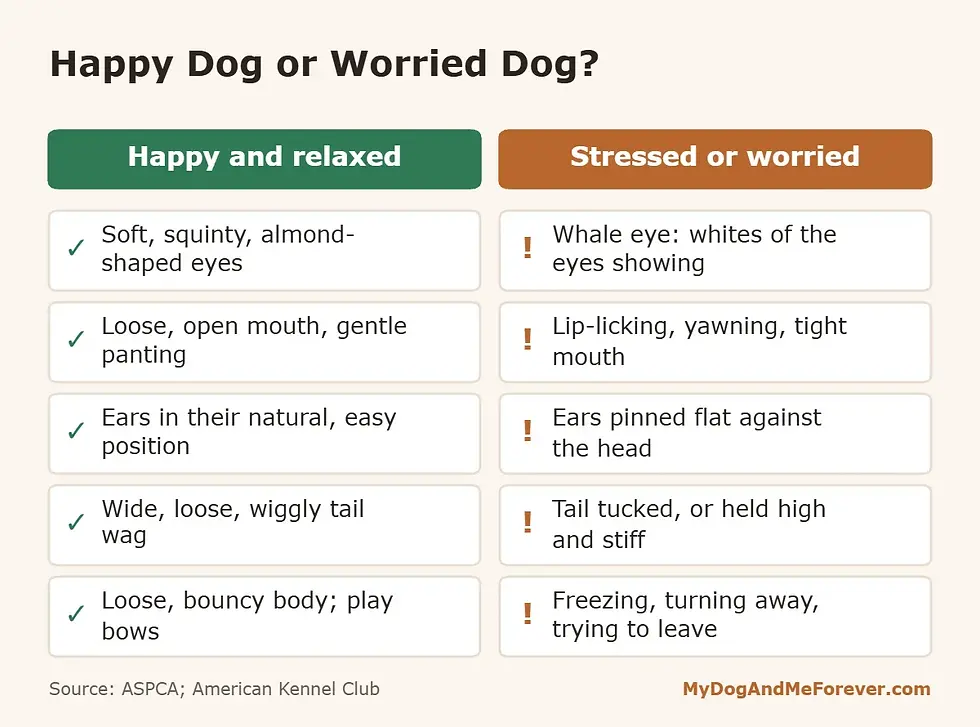
🐾 Worth Knowing A wagging tail doesn't always mean a happy dog. A loose, wide, whole-body wag usually signals friendliness. A tail held high, wagging in short, stiff, rapid movements, can signal tension; a stiff wag held low can signal fear. Watch the whole dog. |
Yawning and lip-licking are easy to miss. A dog who yawns during a hug may be politely saying, "I'm a little uncomfortable." Notice, respond, and your dog learns you are listening.
12 Simple Ways to Bond With Your Dog, Starting Tonight
None cost a penny. Pick two or three, and begin tonight.
1. Share a soft, loving gaze
When your dog is relaxed beside you, let your eyes meet and soften. Smile. Breathe. This is the oxytocin loop at work.
When it's working, you will see soft, squinty eyes, maybe a slow blink, and a body that melts towards you. If your dog looks away, licks their lips or goes still, they are not rejecting you. They are saying a long look feels like a bit much right now. Glance, smile, look away, and let them come back to you. Never force a hard stare, especially on a nervous dog.
2. Talk in "dog-speak"
Use your warm, sing-song voice with words that matter to your dog: their name, "walk," "who's a good boy?" Dogs listen for both the tone and the words, so give them both.
Talk to them through the day, too. Tell them where you're going and when you'll be back. They won't follow every word, but they will hear the warmth. One gentle rule: use your dog's name only for good things. If their name comes before a scolding, they may learn to dread it. Keep it the sound that means joy is coming.
3. Ask before you pet
Many dogs love being stroked; some only at certain times, or in certain spots. Rather than reaching out to a dog, wait for them to come to you, then offer a gentle scratch under the chin or along the back. The Ontario SPCA explains that this approach helps build trust by "giving animals the agency and choice." Let your dog answer for themselves.
🐾 Try This Today The three-second consent test. Let your dog come to you. Stroke them gently under the chin or along the back for about three seconds, or three strokes. Then stop and take your hand away. • If your dog leans in, nudges your hand or stays close, that is a "yes, please." Carry on. • If they move away, that is a polite "no, thanks." Don't follow them. Wait until they come back, then try again. Animal welfare groups such as the Ontario SPCA recommend this simple test. |
4. Learn their language
For one week, simply watch. When does your dog yawn, lick their lips or go loose and wiggly? Jot down what happened just before: the doorbell, a visitor, the vacuum cleaner, the jingle of your car keys. Patterns appear quickly. Soon you will read their feelings before they act on them, and step in to help before a worry becomes a fear.
5. Let them sniff
In a 2019 study in Applied Animal Behaviour Science, dogs given two weeks of daily "nosework," or sniffing-and-searching games, became measurably more optimistic. Once a week, take a slow "sniff walk" and let your dog choose the route. It is their newspaper and their meditation in one.
A good sniff walk looks almost lazy: a longer lead, a quiet path, no destination and no clock. If your dog wants to spend a full minute on one lamppost, let them. The most common mistake is the gentle tug and the cheerful "come on!" the moment their nose goes down. On rainy days, hide a few treats around one room and let them hunt.

6. Play every day
Tug, fetch, hide-and-seek. A few minutes of play, fully present and laughing, says more than words. Let them win sometimes. Joy is the point.
Watch for the play bow, front end down and back end up, and a loose, bouncy body: signs the game feels good to your dog. If play turns frantic, pause for a breather, then start again. Keep a few special toys put away and bring them out only for your games together, so they stay exciting.
7. Train with kindness, never fear
The American Veterinary Society of Animal Behavior recommends reward-based methods for all dog training, warning that aversive methods can have a "damaging effect on both animal welfare and the human-animal bond." A 2020 study of 92 dogs in PLOS ONE found that dogs from schools using aversive methods showed more stress, higher cortisol and a more pessimistic outlook. Your praise is a real reward. Use it generously.
Keep sessions short and cheerful, a few minutes at a time, and end on a success. Reward the instant your dog gets it right, so they know exactly what earned it. If you feel frustrated, stop and play instead. Training should feel like a game you both look forward to.
8. Build small rituals
A morning cuddle before you check your phone. A special word when you leave and return. An evening walk at the same time each day. Small, faithful rituals tell your dog that their world is safe.
Keep goodbyes calm and low-key, so leaving feels like no big deal. Over time, your rituals become a language of their own: the rattle of the lead, the bedtime biscuit, the same soft words at the end of each day.
9. Turn mealtimes into together-time
Hand-feed a few pieces of food, or scatter part of a meal in the garden to sniff out. Food games help nervous dogs link good things with your hands.
A stuffed food toy, a snuffle mat, or kibble hidden under tennis balls in a muffin tin turns a quick gulp into a satisfying puzzle. Sit nearby while your dog works it out, and cheer them on. You become part of the fun, not just the person who puts the bowl down.
10. Be their safe place when the world is scary
It is an old myth that comforting a frightened dog "rewards" their fear. Veterinary behaviourist Dr Sara Bennett explains that "it is very difficult to reinforce an emotional response with comfort." During storms or fireworks, stay close, speak softly and let your dog lean on you.
Prepare ahead. Set up a cosy den, such as a covered crate or a quiet corner with their bed, close the curtains and play soft background sound. Then let your dog choose. Some want your lap; some want to hide. Both are fine. If their fear is severe, talk to your vet, who can help with a behaviour plan.
11. Discover your dog's love language
The brain scans showed that dogs differ: some value praise most, some food, many both. Notice what lights your dog up, whether a belly rub, a ball or simply lying on your feet, and give them more of it.
Try a gentle experiment over a week. On different days, offer a game, a cuddle, a treat hunt and a slow walk, and watch which one makes their tail sweep widest and their eyes go softest. That is their love language. Speak it often.
12. Simply be together
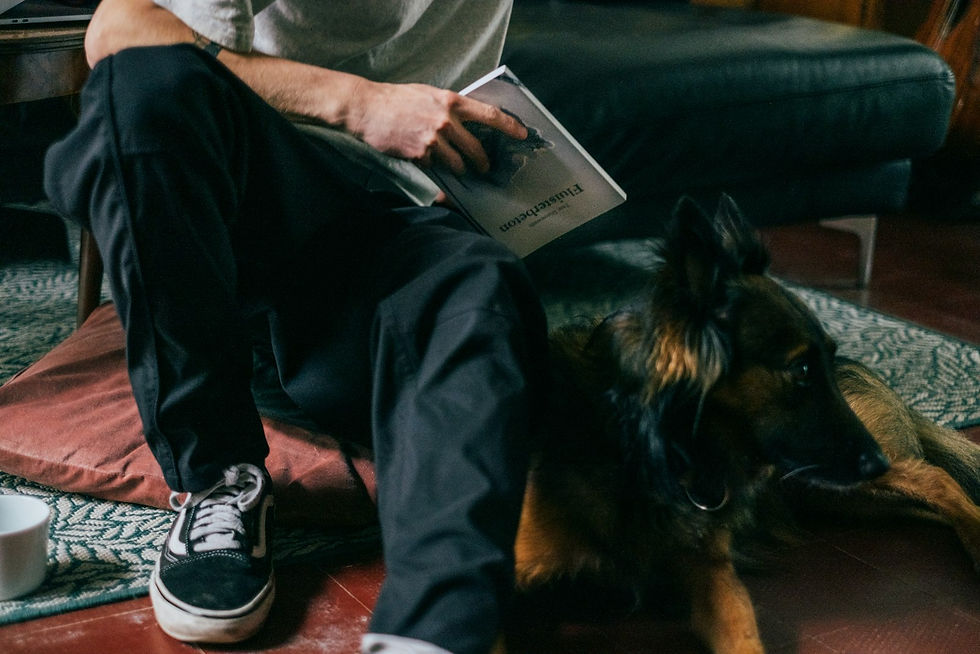
Sit on the floor. Read with your dog stretched against your leg. Leave your phone in another room. Your calm becomes their calm.
Remember the secure base study: it wasn't cheering that helped those dogs. It was simply having their person in the room. You don't always need to do anything. Being there is the gift.
🐾 Vet's Note If your dog suddenly avoids touch, hides, growls when handled or stops enjoying things they used to love, don't assume they have "gone off" you. Changes like these can signal pain or illness, so book a check-up with your vet. And never give your dog human painkillers: several common ones are toxic to dogs. |
What quietly weakens the bond (and how to mend it)
Bonds rarely break in one dramatic moment. More often they fray a thread at a time, without anyone noticing.
Harsh corrections. AVSAB warns that aversive methods can damage the human-animal bond. If you have shouted, jerked the lead or used a punishing tool, you can switch to rewards today. It is never too late to start.
Shifting rules. Allowed on the sofa on Sunday, scolded for it on Monday. Inconsistency makes your dog's world unpredictable. Agree on a few simple house rules with everyone at home, and keep them.
Too much time alone. Dogs are social animals. The RSPCA's advice is simple: never leave your dog alone long enough for them to become distressed. Destructive behaviour, toileting indoors or persistent barking can all be signs of a dog who is struggling.
Walking with your eyes on a screen. Many dogs check in on walks, glancing back at their person. If your eyes are always on your phone, those little moments of connection go unanswered. Pocket it, and look back.
The good news? Every one of these can be mended, starting with your next walk.
The Bond in Every Season of Life
Every stage of your dog's life asks something a little different of you.
The new puppy. Puppies are most open to new people, places and sounds in roughly the first three months of life, the "socialization period." The American Veterinary Society of Animal Behavior notes that puppy classes can start as early as seven to eight weeks, provided the puppy had a first set of vaccines at least seven days before the first class. Gentle, happy first experiences, with you beside them, lay the foundation for a confident adult dog. That matters more than many people realise: AVSAB points out that behaviour problems, not infectious disease, are the leading cause of death for dogs under three years old.
The rescue or adopted adult. Give them time. Humane World for Animals advises keeping the first week or more quiet and consistent, with meals, walks and your comings and goings at the same times each day, and notes that settling in can take days, months or longer. Let your new friend watch, sniff and come to you in their own time. Trust that arrives slowly tends to last.
The older dog. The bouncing puppy becomes a steady companion and, one day, a grey-muzzled old friend who needs you more than ever. If hearing starts to fade, the AVMA suggests teaching hand signals early, and if sight dims, keeping furniture where it is so your dog can find their way by memory. Our complete guide to senior dog care will help you keep them comfortable and close in their golden years.
And when the time comes to say goodbye, the depth of your grief will be a measure of your love. If you are walking that road now, please read our guide to coping with the loss of a dog. You are not alone.
Frequently Asked Questions
How do I know if my dog has bonded with me?
Signs of a strong bond include seeking you out, following you around, relaxing near you, checking in with you on walks and greeting you joyfully. Dogs are also more confident exploring when their owner is nearby, so a dog who treats you as their safe place is showing deep trust.
How long does it take to bond with a rescue dog?
Every dog is different, and dogs with a hard past may need weeks or months. Encouragingly, one study found that adult shelter dogs began showing attachment-like behaviour towards a new person after just three 10-minute sessions.
Is it okay to look into my dog's eyes?
With your own relaxed dog, yes: a 2015 study in Science found that mutual gazing raised oxytocin in both dogs and owners. Avoid hard, fixed stares, especially with nervous or unfamiliar dogs, who may find them threatening.
Do dogs really understand what we say?
Brain-scan research shows dogs process both the meaning of familiar words and our tone of voice, and their reward centres respond most when the two match. So say "good dog!" warmly, not flatly.
Will comforting my scared dog make their fear worse?
No. Veterinary behaviourists explain that comfort is very unlikely to reinforce fear. If your dog's fear is severe or frequent, talk to your vet.
Does my dog love me, or just the food I give them?
Brain-imaging studies suggest it is genuinely you. Dogs' reward centres respond most strongly to the scent of familiar people, and in one study most dogs valued their owner's praise about as much as food, or more.
Go and Sit With Your Dog Tonight
Here is what the science adds up to.
Your dog was shaped, over thousands of generations, to look into your eyes. Their face grew a muscle to reach your heart. Their brain lights up at your scent and your voice. Their eyes grow moist when you come home. When you are near, they are braver. When you cry, many come running.
And you were shaped to answer them.
Fourteen thousand years ago, someone near Bonn sat up with a sick puppy who could give nothing back. A century ago, a scruffy collie walked through an American winter to get home. For almost ten years, an Akita waited at a Tokyo station for a man who never came.
Now it is your turn to write a chapter of that story.
So tonight, put down your phone. Sit on the floor. Let your dog lean into you, look softly into those eyes, and let the oldest love story in the world play out one more time.
That is how to bond with your dog: no tricks, just being there.
Now we'd love to hear from you. Leave a comment below with your dog's name and one thing you love most about them. And if this article warmed your heart, please share it with a fellow dog lover.
Sources and Further Reading
MacLean E. & Hare B., "Dogs hijack the human bonding pathway", Science, 2015
Ed Yong, "Through This Chemical Loop, Dogs Win Our Hearts", National Geographic, 2015
Smithsonian Magazine, report on Kaminski et al. (PNAS) dog eyebrow muscle study, 2019
Waller B. et al., "Paedomorphic Facial Expressions Give Dogs a Selective Advantage", PLOS ONE, 2013
University of York, news release on Benjamin & Slocombe (Animal Cognition), 2018
BBC Science Focus, "Born to be mild: puppies have an innate ability to understand humans", 2021
Berns G. et al., "Scent of the familiar", Behavioural Processes, 2015
ScienceDaily, Emory University release on dogs and familiar human scent, 2014
Scimex, Cell Press release on dog tears study (Current Biology), 2022
Johns Hopkins University Hub, report on "Timmy's in the well" (Learning & Behavior), 2018
Linköping University, news release on Sundman et al. (Scientific Reports), 2019
ScienceDaily, American Heart Association release on dog ownership and survival, 2019
Dall P. et al., dog ownership and physical activity in older adults, BMC Public Health, 2017
University of Liverpool, "Dog owners more likely to meet weekly exercise targets", 2019
BBC Science Focus, "First humans in Americas took their dogs with them", 2021
Natural History Museum, release on oldest genetic evidence for dogs (Nature), 2026
Leiden University, "Emotional bond between humans and dogs goes back 14,000 years", 2018
World History Encyclopedia, "Anniversary of Hachikō's Death" (photo)
Susan Stelljes, "Bobbie the Wonder Dog", Oregon Encyclopedia
UFAW, "Training methods do have an impact on dog welfare", 2020

Comments