When Your Dog Dies, Nobody Tells You This: The Hidden Truth About Losing a Dog and How Love Lives On

The house is too quiet.
No click of nails on the kitchen floor. No contented sigh from the dog bed. You still glance at the door at dinnertime. You still step carefully over a dog who isn't there.
If you are losing a dog right now, or already have, you may be asking why it hurts this much. Why grief ambushes you in the supermarket. Why some people seem to think you should be "over it" by now.
Here is what nobody tells you: what you feel is real, it is normal, and science is finally catching up with what every dog lover's heart has always known.
Let's walk through it together, gently: the bond, the guilt, the children, the other pets, and keeping their memory alive.
Along the way you'll meet a loyal Edinburgh terrier, a grieving poet and a lawyer whose speech about a dead hound is still quoted today.
Why Losing a Dog Hurts This Much
A dog is not a part of your life. A dog is woven through every hour of it.
Your days are built around them: the morning walk, the dinner bowl, the last trip outside before bed.
So when they die, it is not one loss. It is a hundred small ones, every single day.
And a dog accepts you completely, bad moods and all. That kind of unconditional welcome is rare, and its absence leaves an enormous hole.
It is even written in your body chemistry. In a landmark 2015 study in the journal Science, Miho Nagasawa and colleagues in Japan found that when dogs and owners gazed into each other's eyes, oxytocin, a hormone tied to bonding and trust, rose in both. (We explore this in our guide to why the human–dog bond runs so deep.)
No wonder that in a 2023 Pew Research Center survey of nearly 3,000 American pet owners, 97% said their pets are part of the family, and 51% said they are as much a part of it as a human member.
What the research says about pet grief
Grief over a pet was long treated as a lesser sorrow. Research disagrees. A small 2019 Australian study in Death Studies, by Lavorgna and Hutton, found no significant difference in grief severity after losing a person or a companion animal. A larger 2016 study by Eckerd and colleagues found human loss hurt slightly more on average, but its title held the lesson: "Closeness is key."
Then, in January 2026, came striking new evidence. Professor Philip Hyland of Maynooth University surveyed a nationally representative sample of 975 UK adults for the journal PLOS ONE. About a third (32.6%) had lost a beloved pet. Among those who had lost both a pet and a person, more than one in five (21%) said the pet's death was their most distressing bereavement.
And 7.5% of pet-bereaved people met the criteria for prolonged grief disorder, a clinical condition of intense grief that refuses to ease. Look how close that sits to human losses:
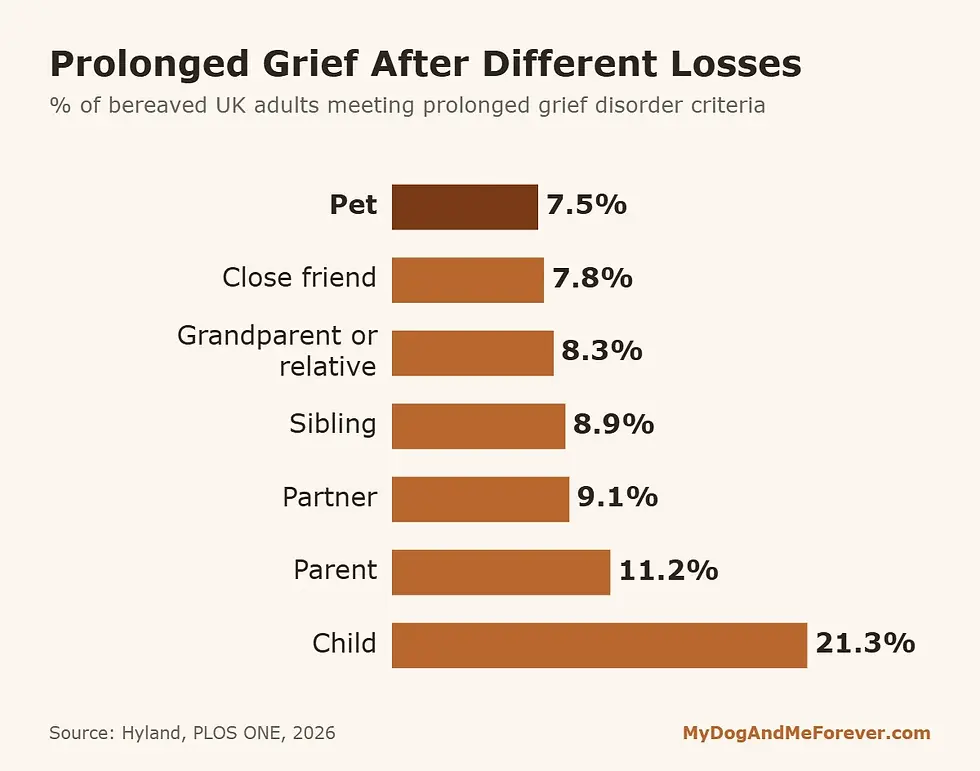
Yet under today's diagnostic manuals, prolonged grief disorder can only be diagnosed after a human dies. Professor Hyland called that exclusion "scientifically misguided."
With around 87 million pet dogs in the United States and 10.2 million in the UK, this is one of the most common heartbreaks on earth. To love a dog is to sign up, one day, for this.
The Grief Nobody Gives You Permission to Feel
"It was just a dog."
Maybe nobody said it aloud. You felt it in the quick change of subject, the expectation that you'd be fine by Monday.
In the late 1980s, grief expert Kenneth Doka gave this a name: disenfranchised grief. It means grief that others don't openly acknowledge or support. No time off work. No meals on the doorstep. No funeral where everyone simply understands.
That silence makes everything heavier. A 2022 review of 36 studies in the journal Omega found dismissive reactions can worsen grief, while social support helps. A 2025 Death Studies study by Elizabeth Peel and Damien Riggs, drawing on 667 UK pet owners, found pet grief was often long-lasting but hidden; some said it hurt more than losing a human relative.
🐾 A Gentle Reminder Your grief is not an overreaction. It is the exact size of your love. • Tell one trusted person what you need: "I lost my dog and I'm really struggling." • It is okay to take a day off, cancel plans or cry in the car. • Spend time with people who loved your dog. They will say their name with you. |
Grief Is Not a Ladder. It Is More Like the Tide.
Most of us know the "five stages of grief": denial, anger, bargaining, depression and acceptance. They come from psychiatrist Elisabeth Kübler-Ross's 1969 book On Death and Dying, and few people realise she drew them from interviews with terminally ill patients. Grief expert David Kessler, her later co-author, stresses that the stages are "not stops on some linear timeline in grief." Not everyone feels them all, or in any set order.
In 1999, researchers Margaret Stroebe and Henk Schut offered a picture many grieving people recognise: the dual process model. In plain words, you swing between two modes:
Loss mode: crying, looking at photos, aching for their warmth.
Life mode: getting through work, making dinner, even laughing at something silly.
Moving between the two is how healthy grieving works; we even need breaks from grief. So laughing with a friend is not a betrayal of your dog, and tears months later are not a failure. It is the tide coming in.
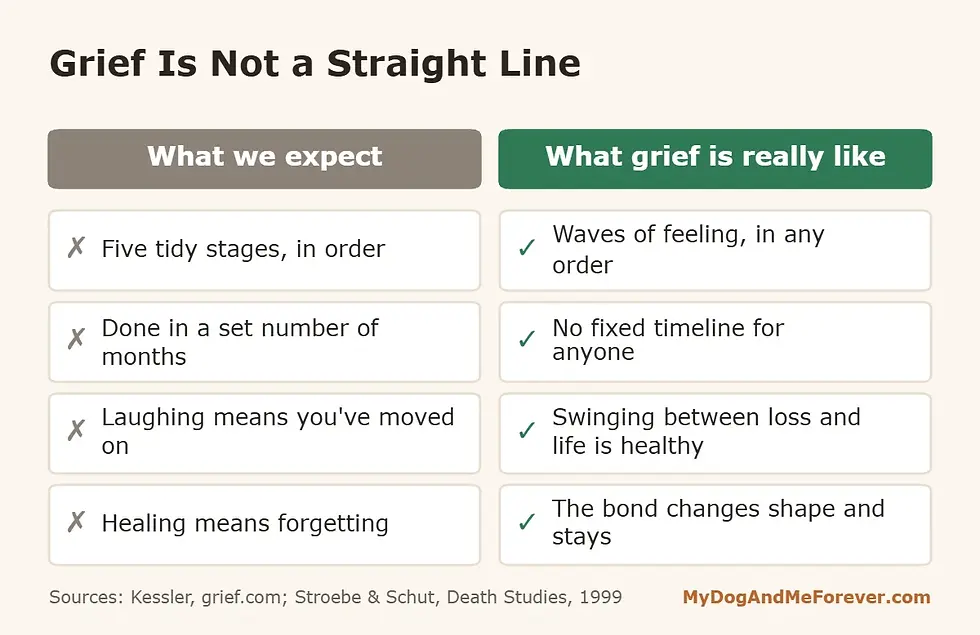
And yes, it does soften. A 2024 Death Studies study of 432 bereaved pet owners found grief was less severe the more time had passed. Not because you love them less, but because you learn to carry it.
🐾 Try This Today Give your grief both room and rest. • Set aside 15 quiet minutes to remember: look at photos, say their name, let the tears come. • Then do one small "life" thing: a short walk, a call to a friend, a proper meal. • Repeat tomorrow. Both halves are part of healing. |
How grief shows up in your body
Grief is not only a feeling. It lives in your body, too.
You may not be able to face food, or you may eat far more than usual. You may lie awake, or dream your dog is still curled at the foot of the bed, then wake and lose them all over again. Bereavement charity Cruse describes all of these as common physical effects of grief, along with aches and pains and catching minor bugs more easily. The NHS adds tiredness and exhaustion, and offers a reassurance worth holding onto: "There's no right or wrong way to feel."
Then there are the moments that catch you off guard. A jingle somewhere, and for one bright second you think it's their tags. Your hand reaching down to stroke a head that isn't there. These moments don't mean you're falling apart. They are your love, still looking for its home.
The NHS and Cruse suggest small, practical kindnesses:
Eat small, simple meals. Regular mealtimes help keep your energy steady.
Move gently. A short walk can ease tension and may help you sleep.
Build a calm bedtime. A warm bath or shower and a quiet routine help a racing mind.
Go easy on alcohol. The NHS warns against using alcohol or drugs to numb grief.
Cruse advises seeing your doctor if breathlessness, a racing heart or panic attacks happen regularly, or if worries about eating, or physical pain, last for several weeks.
The Hardest Kindness: Guilt and the Goodbye Decision
For many owners, the most painful part of losing a dog is not the death itself. It is the decision.
Blue Cross puts it honestly: "few dogs die peacefully in their sleep at home." Most of us will have to choose, and the charity notes that guilt about acting too early, or too late, is common.
Often grief starts before the goodbye; Peel and Riggs found this "anticipatory grief" common among owners of ageing or ill pets. If you are there now, our guide to caring for your dog in their senior years can help make the time left as comfortable and joyful as possible.
How do you know when it's time?
The American Veterinary Medical Association (AVMA) suggests asking whether your dog still enjoys the things they once loved, and whether bad days now outnumber good ones. Your vet can explain the options, but cannot make the decision for you.
Many vets use a quality-of-life scale created by veterinary oncologist Dr. Alice Villalobos. Known by its initials, HHHHHMM, it scores seven areas out of 10 each:
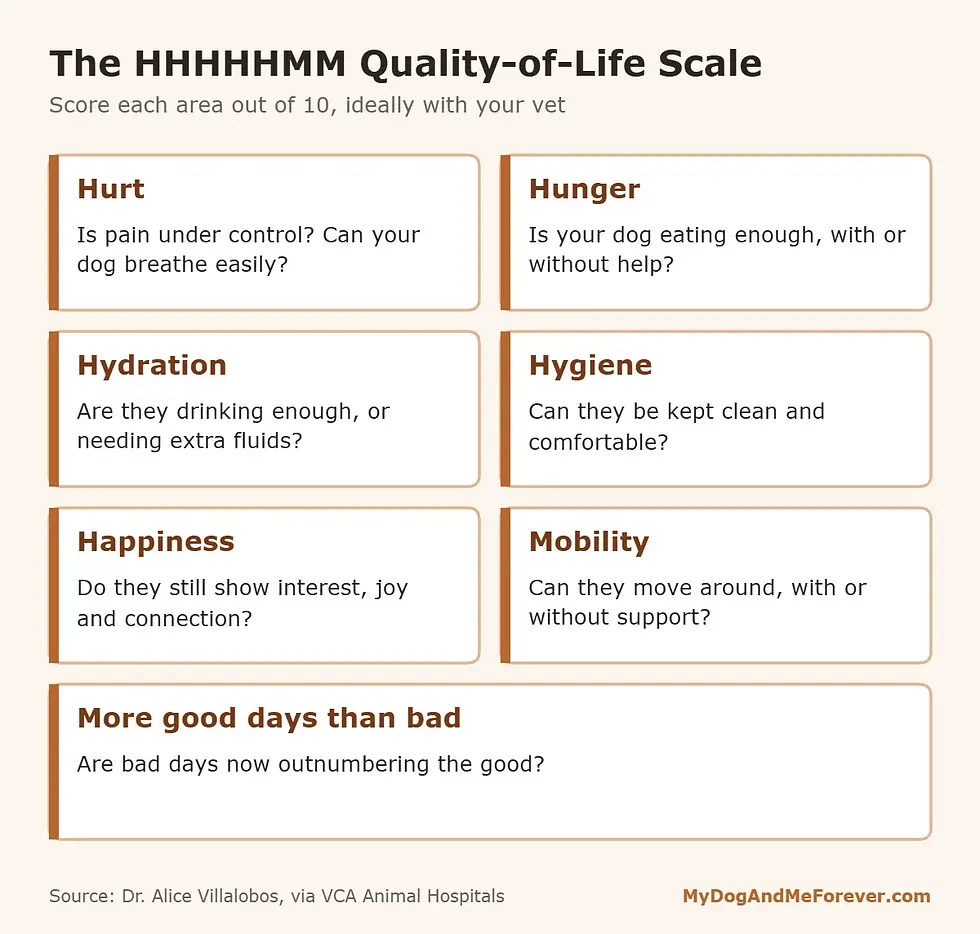
According to VCA Animal Hospitals, a total above 35 suggests quality of life is still acceptable. Scoring regularly can make a painful question clearer.
Making the last days count
If you know the end is near, you have a painful gift: time to say goodbye well.
Blue Cross notes that the days around a goodbye can bring raw and mixed emotions: grief, guilt, numbness, sometimes even calm or relief. None of them make you a bad owner. They make you a loving one.
Bereavement charity Cruse suggests a few gentle ways to use the time you have:
Make a small "bucket list." Not grand adventures, just what your dog loves most: a sunny patch of garden, a slow amble down their favourite path.
Plan a special day. A favourite walk, or a favourite treat (check with your vet first if your dog is on a special diet).
Create a memory box. Their collar, a toy, a photo, a note from each family member.
Write a letter or draw a picture. Children can often pour into a drawing what they can't yet say.
Take photos, too, even of quiet, ordinary moments. In an AKC article, pet photographer Jenna Regan explains that photos taken near the end of a dog's life can help families through their grief. The AVMA adds that saying goodbye, whether with a last evening at home or a visit to the hospital, can help.
Let everyone who loves your dog have their moment: the neighbour who walked them, a grandparent, a student away at college on a video call. A goodbye that is shared is easier to carry.
Being there at the end
Whether you stay in the room is your choice; don't let anyone pressure you, the AVMA says. Blue Cross notes many owners find comfort in being present, and your dog may find it reassuring too.
Usually a sedative is given first, then an injection that works quickly. Any twitch or deep breath afterwards is a reflex, not pain, the AVMA explains. Some vets will also come to your home.
Blue Cross suggests taking time off work, booking a quiet appointment and bringing a friend or relative. You might also bring their favourite blanket, so the last thing they feel is home.
It helps to decide on aftercare beforehand, so you aren't choosing through tears. Blue Cross explains the main options: communal cremation, individual cremation with the ashes returned to you, or burial at home or in a pet cemetery (check local rules first). Your vet can usually look after your dog's body while you decide, and some pet insurance policies cover cremation.
A word about guilt
In 2026, Texas A&M researchers working with the Dog Aging Project published a study in the Journal of the American Veterinary Medical Association comparing owners whose dogs were euthanised with owners whose dogs died without assistance. Grief, guilt and blame showed up at similar rates in both groups.
Guilt is not proof that you chose wrong. It is the shadow of how much you cared. As researcher Dr. Jake Ryave put it: "Loss is loss regardless of how it happens."
🐾 Worth Knowing Before the appointment, ask your vet a few gentle questions. • Can it be done at home, or at a quiet time of day? • Can I hold my dog throughout? • What are my aftercare choices, such as burial or individual cremation? • Can I keep a paw print or a lock of fur? |
Four Loyal Hearts That Prove Love Outlives Death
History is full of people who loved a dog so much they refused to let the world forget.
Greyfriars Bobby: the little dog who (perhaps) never left
In February 1858, Edinburgh police night watchman John Gray died of tuberculosis and was buried in Greyfriars Kirkyard. Legend says his small terrier, Bobby, kept watch near the grave for 14 years.
In 1867 the Lord Provost, Sir William Chambers, paid for Bobby's dog licence and gave him a collar. When Bobby died in January 1872, aged 16, Baroness Angela Burdett-Coutts funded a fountain topped with his statue by William Brodie, unveiled in 1873. It is now Edinburgh's smallest listed building, and Eleanor Atkinson's 1912 novel and a 1961 Disney film carried his story around the world.
Historians debate the details: Cardiff University's Jan Bondeson argues Bobby was a graveyard stray fed by locals, perhaps even replaced by a second dog. But Edinburgh still loves him. His headstone, placed in 1981, reads: "Let his loyalty and devotion be a lesson to us all."

Boatswain: the dog mourned by a poet
Lord Byron's Newfoundland, Boatswain, contracted rabies in 1808. Byron reportedly nursed him himself, wiping the foam from his muzzle with bare hands. Boatswain died at Newstead Abbey that November.
Byron wrote that his dog died "retaining all the gentleness of his nature to the last." He raised a monument larger than his own tomb. Its tribute, written by Byron's friend John Cam Hobhouse, honours a dog:
"...who possessed Beauty without Vanity, Strength without Insolence, Courage without Ferocity, and all the Virtues of Man without his Vices."
Byron's poem on the tomb ends with two of the most heartbroken lines ever written about a dog:
To mark a friend's remains these stones arise; I never knew but one — and here he lies.
In his 1811 will, Byron asked to be buried beside Boatswain. The wish was never granted.

Old Drum: the hound who inspired a famous speech
In 1869, in Missouri, a hound named Old Drum was shot dead. His owner, Charles Burden, sued his brother-in-law, Leonidas Hornsby, who had vowed to shoot any dog on his land after losing sheep.
At the final trial in Warrensburg on 23 September 1870, Burden's lawyer, George Graham Vest, later a United States senator, set the evidence aside and simply spoke about dogs. His "Eulogy of the Dog" holds this famous line:
"The one absolutely unselfish friend that a man can have in this selfish world... is the dog."
He ended his speech at a graveside, with the dog still keeping watch there, "faithful and true, even unto death."
The jury awarded Burden $50, upheld on appeal. Since 1958, a bronze statue of Old Drum by sculptor Reno Gastaldi has stood on the courthouse lawn in Warrensburg. Near the creek where Drum was found, a simple monument raised in 1947 reads "Killed, Old Drum, 1869." Missouri's State Archives describe it as a symbol of every dog people have loved and lost.
"The Power of the Dog": the warning we all ignore
In 1909, Rudyard Kipling published a poem in Actions and Reactions that every grieving dog lover recognises:
Brothers and Sisters, I bid you beware Of giving your heart to a dog to tear.
He describes the moment "the body that lived at your single will" falls still, and how "you will discover how much you care."
"Our loves are not given, but only lent," he wrote. And still, knowing the cost, we give our hearts again and again. That is not foolishness. That is courage.
Helping Children Through the Loss
For many children, the family dog is their first best friend, and this may be their first experience of death. The AVMA advises including children rather than shutting them out, and giving simple, truthful answers.
Choose clear words
Blue Cross warns that "put to sleep" can cause confusion and anxiety for younger children, and recommends plain words like "dead" and "died". Bereavement charity Cruse explains why: a child may fear not waking up at bedtime. Saying the dog went to "live on a farm" can make a child feel responsible, and the American Kennel Club (AKC) warns that blaming the vet can frighten children.
Expect different reactions at different ages
According to Blue Cross, children aged 2 to 4 often struggle to grasp that death is permanent. Those aged 5 to 10 tend to ask concrete questions, such as whether it hurt. From around 9, most understand death is final. Teenagers may share less, yet may have felt closer to their dog than to anyone.

🐾 Words That Help Simple, honest words are kinder than gentle-sounding ones that confuse. • "Buddy died. His body stopped working, and he can't come back." • "The vet helped him die peacefully so he wouldn't hurt any more." • "It's okay to feel sad, or angry, or nothing at all. I'm sad too." • Invite them to help: choose a burial spot, plant bulbs, or draw a picture. |
Let them see you grieve, too. When a child watches a parent cry and carry on, they learn that sorrow is survivable, and that love is worth it.
Your Other Dog May Be Grieving Too
If you have another dog, you may have noticed something heartbreaking. They seem lost.
In 2022, an Italian-led team including Stefania Uccheddu and Federica Pirrone published a study in Scientific Reports titled "Domestic dogs (Canis familiaris) grieve over the loss of a conspecific." They surveyed 426 owners whose household had lost one dog while another survived. A remarkable 86% noticed changes in the surviving dog's behaviour.
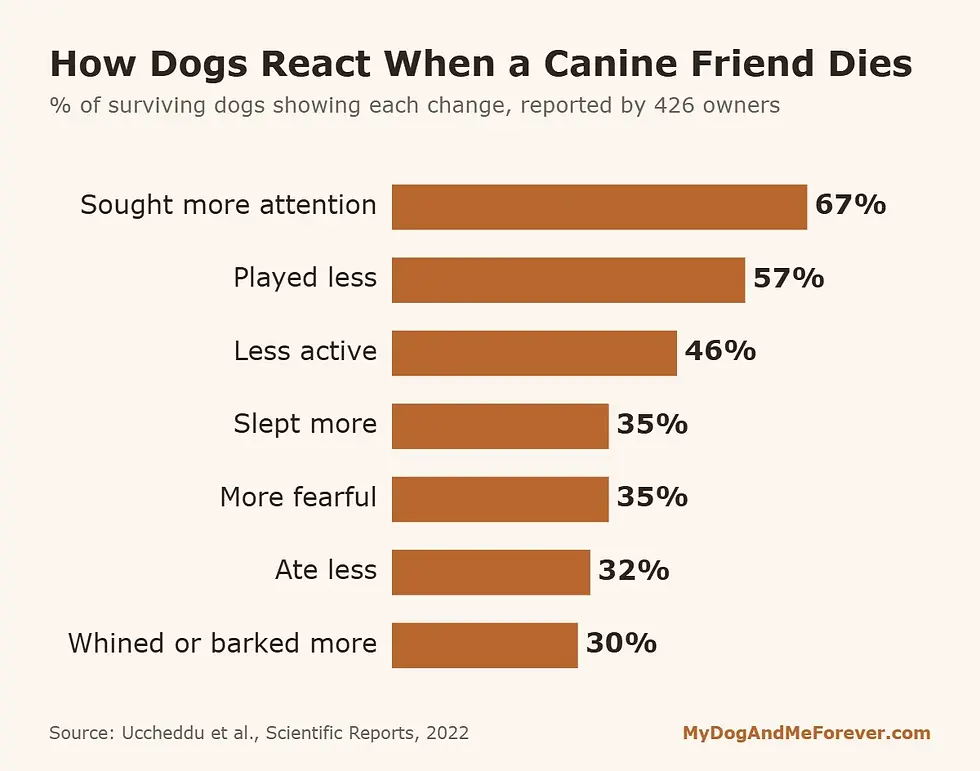
For about a third, the changes lasted two to six months; for a quarter, longer. The authors can't prove the dogs were grieving, but the pattern is hard to ignore.
A 2016 study in Animals by Walker, Waran and Phillips found 30% of 159 bereaved dogs sought out their lost companion's favourite spot.
How to help a grieving dog
Keep the routine steady. Blue Cross notes dogs are creatures of habit; familiar mealtimes and walks reduce stress.
Offer comfort, and space. The AKC suggests an extra walk or cuddle, while also allowing quiet time.
Redirect waiting gently. If your dog waits by the door, calmly guide them to play and praise calm behaviour.
Watch their appetite. If your dog stops eating or seems very lethargic, see your vet; illness can look like grief.
Don't rush a new companion. Blue Cross advises against hurrying into another pet just for the surviving dog.

Ways to Keep Their Memory Alive
Here is a truth that brings real comfort: you do not have to "let go" of your dog to heal.
Grief researchers call it continuing bonds: our relationship with those we lose doesn't end; it changes shape. The 2022 Omega review found these bonds can cut both ways, but they can ease loneliness, and rituals and memorials can help.
The goal is not to cling to the pain. It is to carry the love.
Memorial idea | Why it helps |
Keep a paw print or lock of fur | A touchable keepsake of their warmth |
Write a letter to your dog | Says the things you wish you'd said |
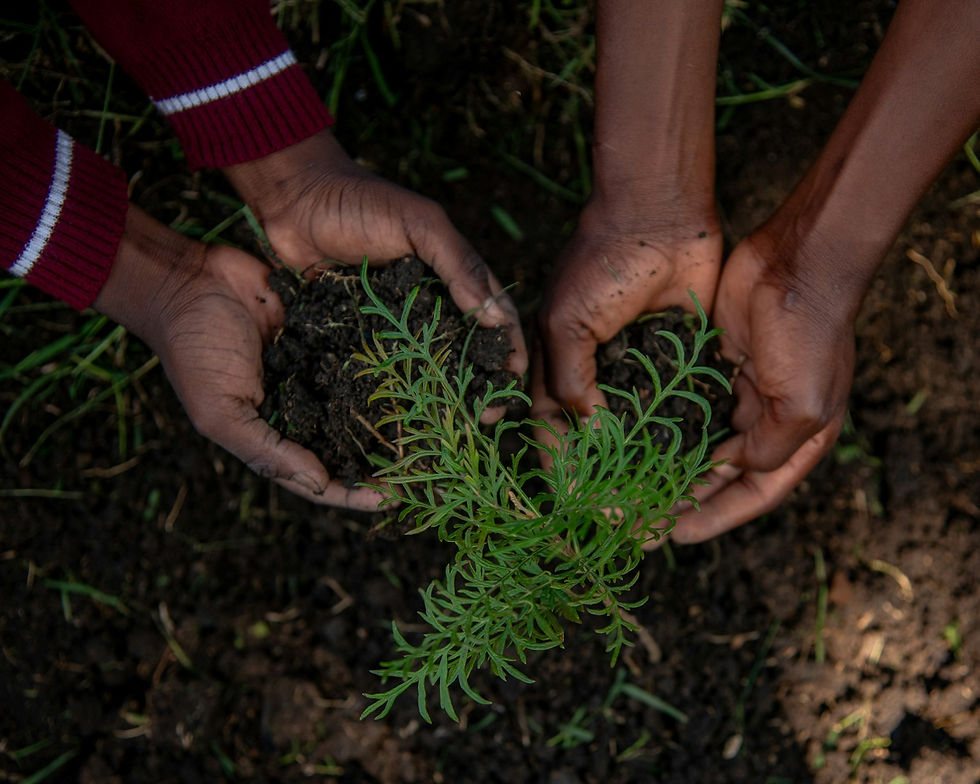
Plant a tree or spring bulbs | Blooms in their name each year |
Make a photo book or memory box | Gathers their life story in one place |
Hold a small ceremony | Gives family and friends a shared goodbye |
Scatter ashes somewhere special | Returns them to a place they loved |
Donate or volunteer in their name | Turns grief into help for other dogs |
The bed, the bowl, the lead: there's no rush
Few moments are as raw as facing their things. The lead on its hook. The bowl by the back door. The bed still shaped like them.
There is no right time to tidy them away. Some people leave everything as it was for a while; others pack things up within days because each glimpse hurts. Both are acts of love. If you're unsure, try a middle path: put the bed and bowls away, but keep the collar and a favourite toy where you can hold them. Later, a local rescue may welcome unopened food or blankets (call first), and it can feel good to know your dog's things are comforting another dog.
Getting through the "firsts"
The early weeks bring a string of firsts: the first morning with no walk, the first time you come home to silence, the first holiday, the first birthday without them. Blue Cross notes that dates such as their birthday or the day they came home, and places you often visited together, can bring grief flooding back. When you're ready, those days can become a way to celebrate the bond you shared.
A few small rituals can help:
At walk time, step outside anyway, even for five minutes on your old route.
On their birthday, the AKC suggests volunteering at a rescue or donating to an animal charity in their name.
On a favourite walk, remember that ashes can be scattered somewhere you both loved, as Blue Cross notes.
At MyDogAndMeForever, keeping that memory alive is close to our hearts. Every dog deserves a place where their name is spoken, their story is told and their love is remembered, forever.
Will You Ever Be Ready for Another Dog?
Some people feel they could never love another dog. Others find the silence unbearable within weeks. Both are normal, and the AKC is clear there is no fixed timeline. Veterinarian Dr. Mary Gardner, co-founder of Lap of Love, told the AKC: "Sometimes the silence in the home is too much for a grieving owner."
A few gentle questions can help:
Am I hoping for a new dog, or hoping to get my old dog back?
Is everyone in the family ready, including our current pets?
Can I let this new dog have their own personality, without comparing?
The AVMA suggests waiting until the family agrees on timing and grief has eased for anyone struggling. A new dog never replaces the one you lost. They open a new chapter, written alongside the old one.
You Don't Have to Carry This Alone
These services can help right now:
United Kingdom: Blue Cross Pet Loss Support has helped grieving owners since 1994, supporting around 20,000 people in a recent year. It is free and confidential, open 8.30am to 8.30pm every day on 0800 096 6606, with email and webchat too.
United States: The Tufts Pet Loss Support Helpline (508-839-7966), staffed by volunteers at Tufts University's veterinary school, answers Monday to Thursday evenings. Cornell University's Pet Loss Support Hotline (607-218-7457) is run by trained veterinary students; hours vary by season.
Online: Lap of Love runs free weekly virtual pet loss support groups led by certified pet loss coaches.
Anywhere: Ask your vet. Many clinics and animal charities know local support groups.
🐾 When to Reach Out Grief can be crushing and still be healthy. But if it is overwhelming, or affects your sleep, work, eating or relationships for a long time, please speak to your doctor or a counsellor. That is not weakness; it is care. If you ever feel unsafe, contact emergency services or a crisis line right away, such as Samaritans on 116 123 in the UK or 988 in the US. |
Questions Grieving Owners Ask
Is it normal to grieve a dog as much as a person?
Yes. In a 2026 PLOS ONE study, 21% of people who had lost both a pet and a person said the pet's death was their most distressing loss. Prolonged grief after pet loss was about as common as after losing a close friend or sibling.
How long does grief last after losing a dog?
There is no fixed timeline. Grief usually comes in waves that slowly soften with time. Anniversaries and familiar places can bring it back, and that is normal.
Did I make the right decision to euthanise my dog?
If you chose with love, guided by your vet, to spare your dog suffering, you gave them a final kindness. Dog Aging Project research found guilt is just as common when dogs die naturally.
Should I tell my child the dog was "put to sleep"?
It's better to use clear words like "died". Blue Cross warns that "put to sleep" can confuse and worry younger children. Be honest, keep it simple, and invite them to help with a memorial.
Do dogs grieve when another dog in the home dies?
Many appear to. In a 2022 study of 426 owners, 86% saw behaviour changes in the surviving dog, such as more attention seeking and less play. Keep routines steady, and see your vet if your dog stops eating.
When should I get another dog?
Only when it feels right for you, your family and any pets you have. Some are ready in weeks, others in years. A new dog never replaces the one you lost; they begin a new story.
Love Doesn't End. It Changes Shape.
Somewhere in your home there may still be a few stray hairs on the sofa. A chewed toy under the bed. A dent in the cushion where they always lay.
Leave them a while, if you like. There's no hurry.
Losing a dog is one of the most painful things a loving heart can go through. But Greyfriars Bobby, Boatswain, Old Drum and every dog who ever waited by a window teach us this: love doesn't stop when a heartbeat does. It simply changes shape.
It becomes the way you smile at every dog in the park. The patience they taught you. The quiet certainty that, for one bright stretch of your life, you were someone's whole world.
They gave you their entire life. Now you carry their love for the rest of yours. And if you have a dog beside you today, go and hold them a little longer.
We'd love to hear about your dog. Leave a comment below with their name and one thing you love about them. Every name shared here is a name remembered. And if you know someone grieving a dog right now, please share this article with them. It may be exactly what they need today.
Sources and Further Reading
Maynooth University, "Death of a pet can be as intense as loss of a person", 2026
Aalborg University, "Pet grief" (Lavorgna & Hutton; Eckerd et al.)
Flinders University, "Hidden heartache of losing an animal companion", 2026
PsyPost, "Attachment styles and pet grief" (Lykins et al.), 2024
Fiset & Plourde, "Oxytocin-gaze loop" commentary, Frontiers, 2015
Uccheddu et al., "Dogs grieve over the loss of a conspecific", Scientific Reports, 2022
Walker, Waran & Phillips, "Owners' perceptions", Animals, 2016
Blue Cross, "Coping with the loss of a pet: a support guide"
Comments