The 7 Magic Moments of Your Puppy's First Week (Have Your Camera Ready)


On a spring day in April 2009, one of the most photographed families on earth walked a six-month-old Portuguese water dog onto the South Lawn of the White House.
The photographers had their lenses up. The President's daughters ran. The puppy, Bo, bolted across the grass on his new leash like he owned the place.
The President made one house rule clear from day one: "Not in my bed."
That day, the White House shared the photos and video of "Bo's first day" with the world. Of everything that happened that spring, it is those pictures of a goofy, curly puppy running on the grass that still make people smile.
You don't need a team of White House photographers. You need a phone, a little charge in it, and to know what you are looking for. Because your puppy's first week is short, it goes by in a blur of naps and paper towels, and the moments that matter most last only a few seconds.
Here is the short answer. In a puppy's first week home, most puppies sleep 18 to 20 hours a day, explore their new world nose-first, learn their name, choose a favorite toy, start following you from room to room, hold your gaze for the first time, and finally settle into their bed with a deep sigh that says "I'm home." Your job is to keep the week calm, safe and predictable, and to have your camera ready for those 7 magic moments.
This guide walks you through all 7, day by day, with what the science says about each one, how to capture it beautifully, and what is normal along the way.
🐾 Key takeaways • Your puppy's first week is about safety, sleep and trust, not training drills. Keep the world small and calm. • Puppies this age sleep 18 to 20 hours a day, so most magic moments happen in short awake windows. Keep your phone close. • The 7 moments: the doorway sniff, the first collapse nap, the first name turn, the first toy claim, the first follow, the first long gaze, and the "I'm home" sigh. • Shoot from your puppy's eye level, use natural window light, and never use a flash. • Book a vet check in the first week, take your puppy out often, and know the warning signs that mean "call the vet today." • Grab the free First Week Photo Shot List further down and tick off each moment as you catch it. |
Why Your Puppy's First Week Matters More Than You Think
Your puppy has arrived in the middle of the most important learning window of their life.
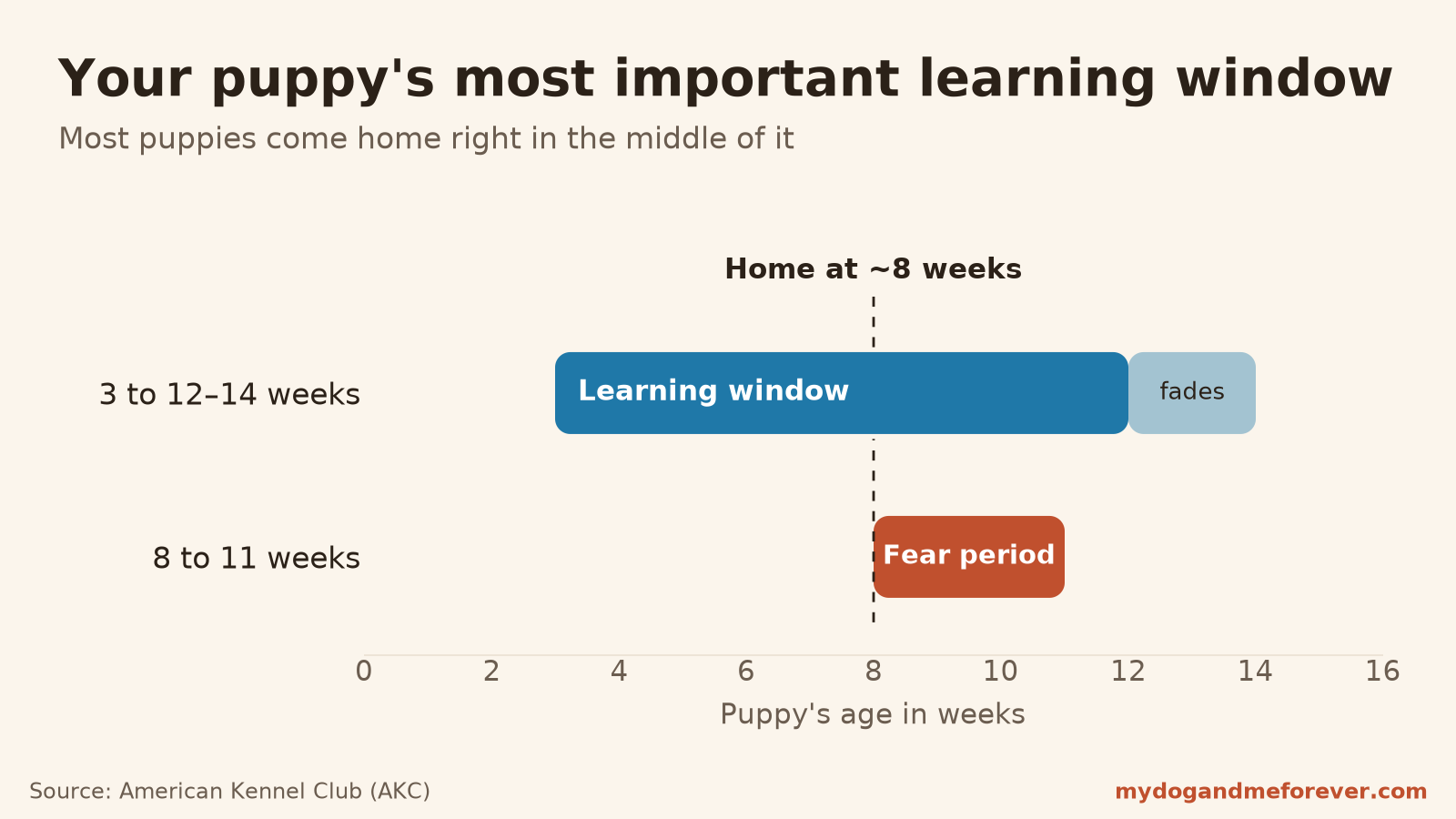
According to the American Kennel Club (AKC), puppies go through a critical socialization period from about 3 weeks of age until 12 to 14 weeks. Experiences in this window help shape how your dog will feel about people, places and sounds for years to come.
Most puppies come home at around 8 weeks old. That means you are getting the last few weeks of that window, and the first week is where it starts.
There is a twist, though. The AKC also notes that most puppies go through their first fear period at around 8 to 11 weeks, right when they are leaving their mother and littermates. A puppy in this stage can be more easily spooked, and a frightening experience can stick.
So the first week has a delicate balance. You want gentle, happy new experiences. You do not want a parade of visitors, loud parties or rough handling.
Think of it as a honeymoon, not a boot camp.
A week that goes faster than you think
Here is something no one tells you when you bring a puppy home: that tiny body is leaving fast.
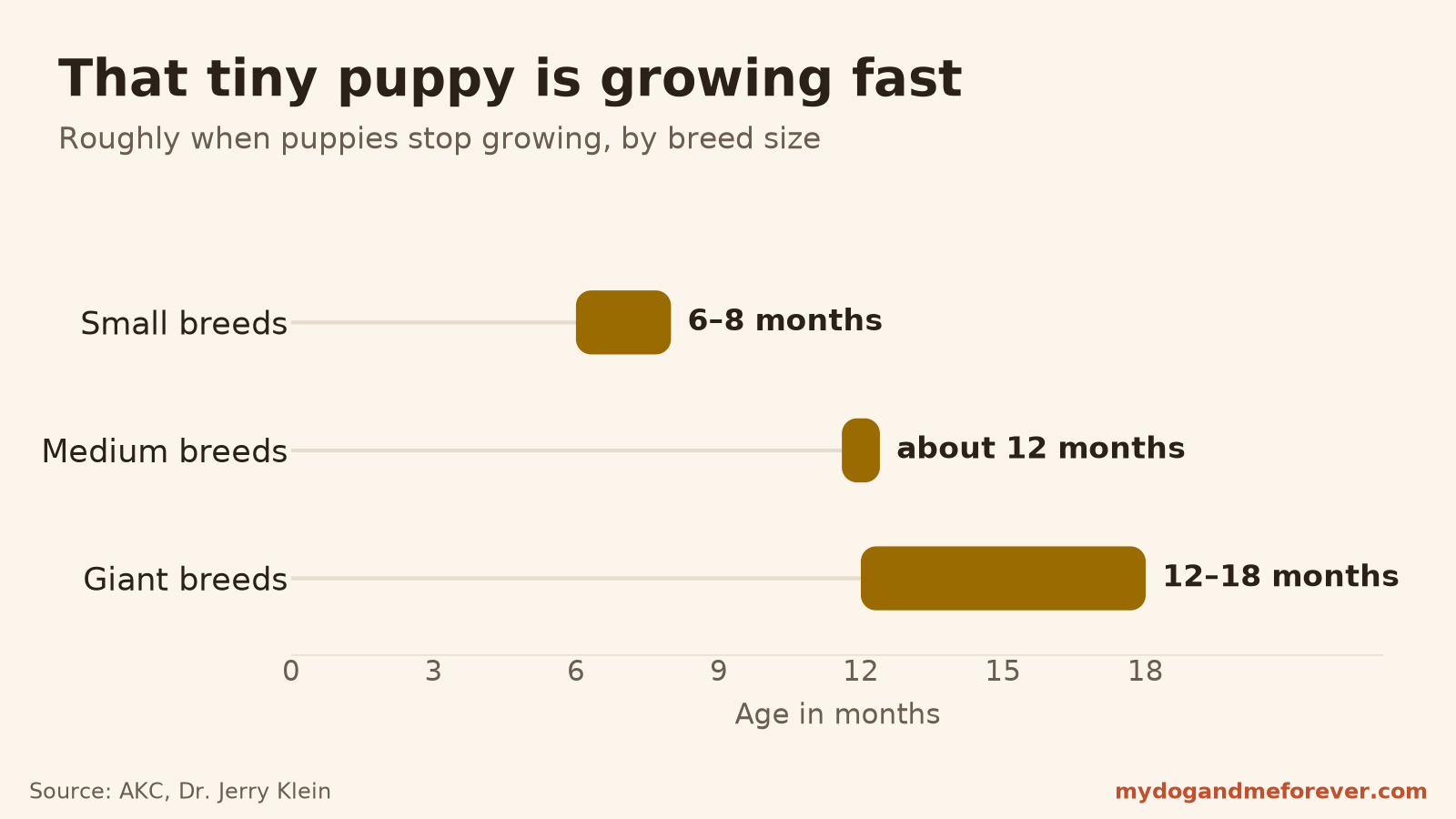
The AKC's chief veterinary officer, Dr. Jerry Klein, says small breeds usually stop growing by around 6 to 8 months, medium breeds at around 12 months, and giant breeds keep going until about 12 to 18 months.
The puppy who fits in your two cupped hands this week may not fit on your lap by summer.
That is why this week deserves a camera. Not for social media. For you, ten years from now, on a quiet evening with a grey-muzzled dog asleep at your feet.
Before the Magic: 5 Camera Habits for the Whole Week
You don't need expensive gear. The best puppy photos are almost always taken on a phone, by someone who was patient and ready.
No. 1: Get down low. Lie on the floor. Photos taken from your puppy's eye level feel intimate and alive. Photos taken from standing height make every puppy look like a small furry rug.
No. 2: Use window light and turn off the flash. A flash can startle a young puppy and gives them glowing "demon eyes" in the photo. Soft daylight from a window is kinder and far more beautiful.
No. 3: Use burst mode and video. Puppies move in jerks and wobbles. Hold the shutter for a burst, or film a short clip and pull your favorite frame out later.
No. 4: Keep your phone charged and within reach. Most magic moments last 5 to 30 seconds. If your phone is in another room, you will miss it.
No. 5: Put your puppy first, the photo second. If your puppy is tired, scared or overwhelmed, put the phone down. A calm puppy matters more than any picture.
One more quiet tip: get in some of the photos yourself. Years from now, the pictures you will treasure most are the ones with your hands, your lap and your face in them.
Your Puppy's First Week, Day by Day
Every puppy is different, but most new owners see the moments below unfold in roughly this order. Use it as a gentle guide, not a test.
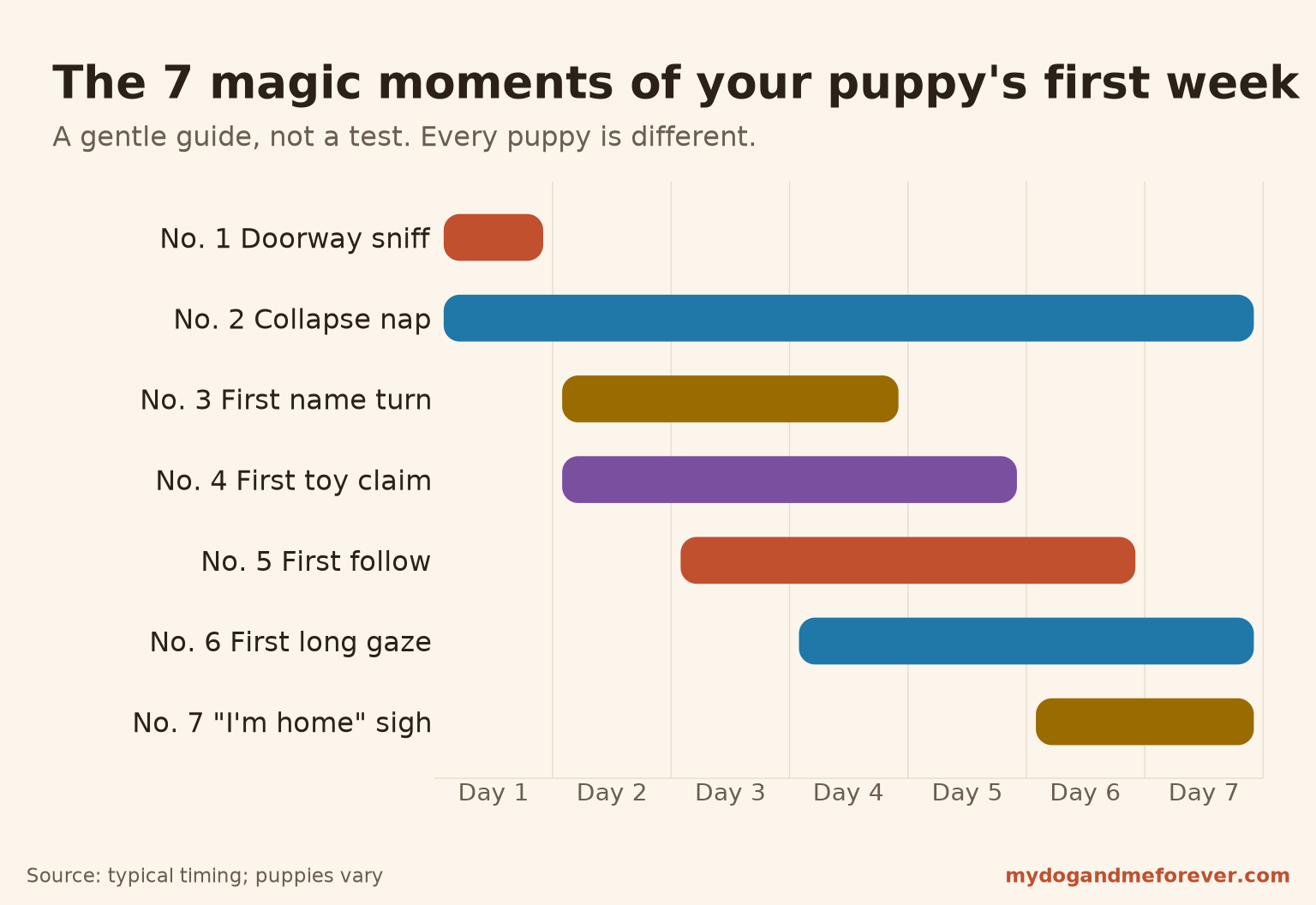
Day 1: The arrival, the doorway sniff, and the first collapse nap.
Days 2 to 4: Your puppy starts turning to their name and claiming a toy.
Days 3 to 6: The first follow. You become your puppy's favorite place to be.
Days 4 to 7: The first long, soft gaze, and the "I'm home" sigh at the end of the week.
If your puppy is shy, rescued, or had a rough start, these may take longer. That is completely normal. Many trainers use the "3-3-3 rule" as a rough guide: 3 days to decompress, 3 weeks to learn your routine, and 3 months to feel truly at home.
Now, let's walk through each moment.
Magic Moment No. 1: The Doorway Sniff (Day 1)
It happens in the first ten seconds.
You open the door, set your puppy gently down, and their nose goes to work. Sniff the doormat. Sniff your shoe. Sniff the corner of the rug as if it holds the secrets of the universe.
This is your puppy meeting their new home the way dogs meet everything: nose first.
Why it matters
A few hours ago, everything your puppy knew smelled like their mother and littermates. Now the whole world smells new. That first slow sniff is your puppy beginning to map their new life.
This is also why the first day should be quiet. Show your puppy one small, safe area to start, like the kitchen or a puppy pen, rather than the whole house. A small world feels safe. A big, loud one feels overwhelming.
How to capture it
Have someone else carry the puppy in, so you can film from the floor just inside the door.
Start recording before the door opens. The first sniff happens fast.
Keep the shot wide enough to show the doorway. Years later, you'll love seeing the place where it all began.
Take one photo of your puppy beside something for scale, like your shoe or their new food bowl. It's the photo you'll compare to next year.

Magic Moment No. 2: The First Collapse Nap (Day 1 and Beyond)
One minute your puppy is wobbling after a toy. The next, they are face-down on the rug, legs splayed, fast asleep mid-step.
Welcome to the collapse nap. It is one of the funniest, most tender things you will ever see, and it will happen many times a day this week.
Why it matters
Sleep is not wasted time for a puppy. It's when their growing brain and body do much of their work.
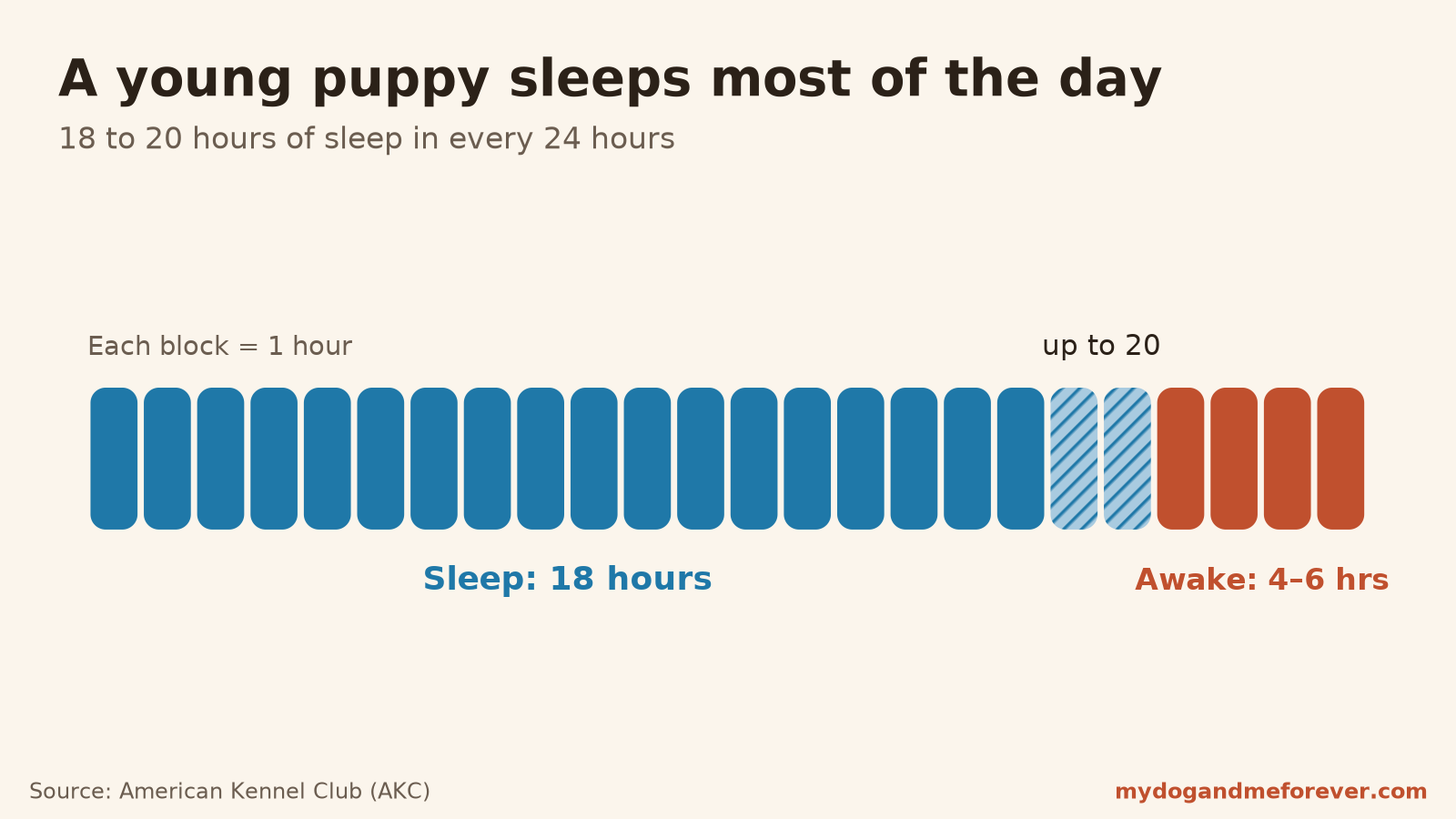
According to the AKC, puppies typically need 18 to 20 hours of sleep a day. A puppy may nap every hour or so, sleeping anywhere from 30 minutes to two hours at a time.
Then there are the twitches. You may see little paws paddle, whiskers flick, and tiny yips during sleep. The AKC explains that puppies and senior dogs twitch in their sleep more than middle-aged dogs. One theory is that the part of the brain stem that keeps muscles still during dreams is still developing in puppies.
In other words, your puppy may already be dreaming. And it's quite possible they are dreaming about their brand-new life with you.
How to capture it
Switch off the flash and the shutter sound. Never wake a sleeping puppy for a photo.
Shoot from the side, at bed level, to catch the round belly and the soft ears.
Film 20 seconds of the dream twitches. It's the clip you will watch again and again.
If your puppy falls asleep on your lap, ask someone to photograph you both from above. This is one of the most treasured photos new owners ever take.
A gentle note: if your puppy seems unusually sleepy and also won't eat, has diarrhea or vomiting, or has pale gums, don't wait. Call your vet the same day.
For more help with the hardest part of day one, see our guide to the first night with your new puppy.
Magic Moment No. 3: The First Name Turn (Days 2 to 4)
You are sitting on the floor. Your puppy is busy chewing a corner of a blanket. You say their name, softly, in a happy voice.
And they stop. They lift their head. They turn and look right at you.
It's a tiny moment. It's also the first time your puppy answers you.
Why it matters
Your puppy came into the world ready for this.
In 2021, researchers at the University of Arizona tested 375 puppies that were about 8 weeks old. The puppies were training to become service dogs with the nonprofit Canine Companions, and they still lived with their mother and littermates, with little one-on-one human time.
Even so, many of them followed a person's pointing finger to find a hidden treat, often from the very first try. The researchers, led by Dr. Emily Bray, concluded that puppies are biologically prepared to understand human communication from a very young age.
There was a catch. The puppies paid the most attention when the person spoke to them first, in a warm, high-pitched voice.
That fits with another study. In 2017, scientists recorded people speaking in "dog-directed speech", the sing-song voice most of us use with puppies without thinking, and played it to dogs. Puppies reacted strongly to the high-pitched voice. Adult dogs reacted about the same to both voices.
So go ahead and use your silly puppy voice. Science is on your side.
How to capture it
Ask a family member to film while you call your puppy's name softly from a few feet away.
Use your happiest, highest voice and say the name only once.
Reward the turn with a tiny treat or a gentle stroke, so your puppy learns their name means something good.
Never use your puppy's name to scold them this week. Keep it a word that only ever means love.
Magic Moment No. 4: The First Toy Claim (Days 2 to 5)
Out of the basket of toys you bought, your puppy will pick one.
It may be the most expensive toy. More often, it's the cheapest, the squeakiest, or a sock you didn't mean to give them. They will carry it everywhere, sleep with it, and guard it like treasure.
That toy is about to become one of your most precious keepsakes.
Why it matters
In August 2013, the White House introduced a second Portuguese water dog, Sunny, to join Bo. In the photos released that day, the young dog trotted across the North Lawn with what appeared to be a pink flamingo toy.
It's a small detail, but it's exactly the kind of detail that makes a photo unforgettable. That's the power of the first toy. It turns a puppy into a personality.
A favorite toy also gives your puppy comfort in a new home. Something familiar to carry, chew and curl around helps a nervous puppy settle.
How to capture it
Photograph your puppy carrying the toy, head high and proud. That trot is pure joy.
Take a still photo of the toy by itself, too. Puppies chew toys to pieces, and one day you'll wish you had a picture of it whole.
Keep the toy safe if it starts falling apart. Many owners keep that first toy for the rest of their dog's life, and long after.
Check toys daily this week and remove any small pieces that could be swallowed.
If you are wondering what toys a puppy really needs (fewer than you think), read Your Puppy Doesn't Need a $90 Toy.

Magic Moment No. 5: The First Follow (Days 3 to 6)
You get up to put the kettle on. You hear tiny nails on the floor behind you.
You walk to the laundry room. There they are again.
Sometime in the first week, your puppy decides that wherever you are is the best place to be. Their little shadow follows you from room to room, and when you sit down, they flop against your feet.
Why it matters
This is your puppy choosing you.
For the first days, your puppy was surviving: sleeping, eating, sniffing, learning where things are. When they start following you, they are beginning to see you as their safe base in a confusing new world.
It's also the perfect time to teach a very important lesson gently: being alone for a few minutes is safe. Many vets and trainers recommend short, calm separations from the first week, such as stepping out of the room for a minute or two while your puppy chews something in their pen, then coming back quietly. This helps prevent separation stress later.
Being your puppy's favorite place is a gift. Teaching them they are also okay on their own is a gift, too.
How to capture it
Film the "shadow shot": hold your phone low and behind you as you walk, catching your feet and your puppy trotting behind.
Photograph your puppy asleep on or against your feet. It's one of the most loved puppy photos there is, and it often becomes a lifelong habit.
Film the first time your puppy greets you at the gate or door after a short separation. Watch the whole body wag.
For more on gentle routines like this, see Start These 9 Habits on Day One.
Magic Moment No. 6: The First Long Gaze (Days 4 to 7)
This is the moment most new owners miss, because it doesn't look like much.
Your puppy is lying near you, calm and sleepy. You look down. They are already looking up at you. Not at your hands, not at the treat bag. At your face.
The look is soft. The eyes are relaxed. And for a few seconds, neither of you looks away.
Why it matters
Scientists have spent years studying that look, and the findings are beautiful.
Researchers at Azabu University in Japan, including Professor Takefumi Kikusui, have studied how dogs and their people bond through eye contact and the hormone oxytocin, often called the "love hormone." Their work found that gentle mutual gazing between dogs and their owners is linked to rises in oxytocin in both.
The story of how Professor Kikusui began one of his best-known recent studies is pure magic. When one of his own standard poodles had puppies, he noticed something change in her face as she nursed them: her eyes became teary.
That small observation led to a 2022 study in the journal Current Biology. His team measured the tears of 18 dogs as they were reunited with their owners after being apart for more than five hours. The dogs' eyes produced more tears when they were reunited with their owner. That increase wasn't seen when 20 dogs were reunited with a familiar person who wasn't their owner.
In the same study, people shown photos of dogs with teary eyes felt more like caring for them.
Your puppy's soft gaze this week is the very beginning of that bond.
How to capture it
This moment is better felt than staged. Don't stare hard at a nervous puppy. Strong, fixed eye contact can feel threatening to a young dog.
When the soft gaze happens naturally, raise your phone slowly and take a selfie with your puppy looking up at you.
Or ask someone to photograph the two of you from the side, so they catch both faces in the same frame.
If you miss it, don't worry. Now that you know what to look for, it will come again, and again.
Want to understand this look more deeply? Read That Look Your Dog Gives You Is Real Science.

Magic Moment No. 7: The "I'm Home" Sigh (Days 6 to 7)
You'll know it when you hear it.
Near the end of the week, your puppy walks to their own bed, turns around once or twice, and drops down. Then comes a long, deep, whole-body sigh.
Maybe they roll onto their side. Maybe they show their belly. Their eyes close slowly. They are not hiding, not watching the door, not crying for their littermates.
They are home.
Why it matters
The first week is a big adjustment for a puppy. Many arrive quiet, unsure, a little clingy, and they may cry at night, eat less than you hope or seem withdrawn for the first few days. By the end of the week, many puppies show more curiosity, more confidence and a clearer sense of the daily routine.
That sigh is a sign your puppy is starting to trust the rhythm of their new life: the same bed, the same voices, the same people, the same gentle routine, day after day.
It is also, quietly, your report card. You did it. You made a safe place for a small, brave creature who left everything they knew to be with you.
How to capture it
Film the whole thing: the turning circle, the drop and the sigh. Keep the sound on.
Take a photo of your puppy asleep in the bed from the same spot where you took their first-day photo. Put the two side by side. You'll be amazed how much has changed in seven days.
Then put the phone away and just watch. Some moments are for your memory, not your camera roll.

Your Free First Week Photo Shot List
Print this list and stick it on the fridge. Tick off each moment as you catch it. By the end of the week, you'll have the start of a story you'll treasure for the rest of your dog's life.
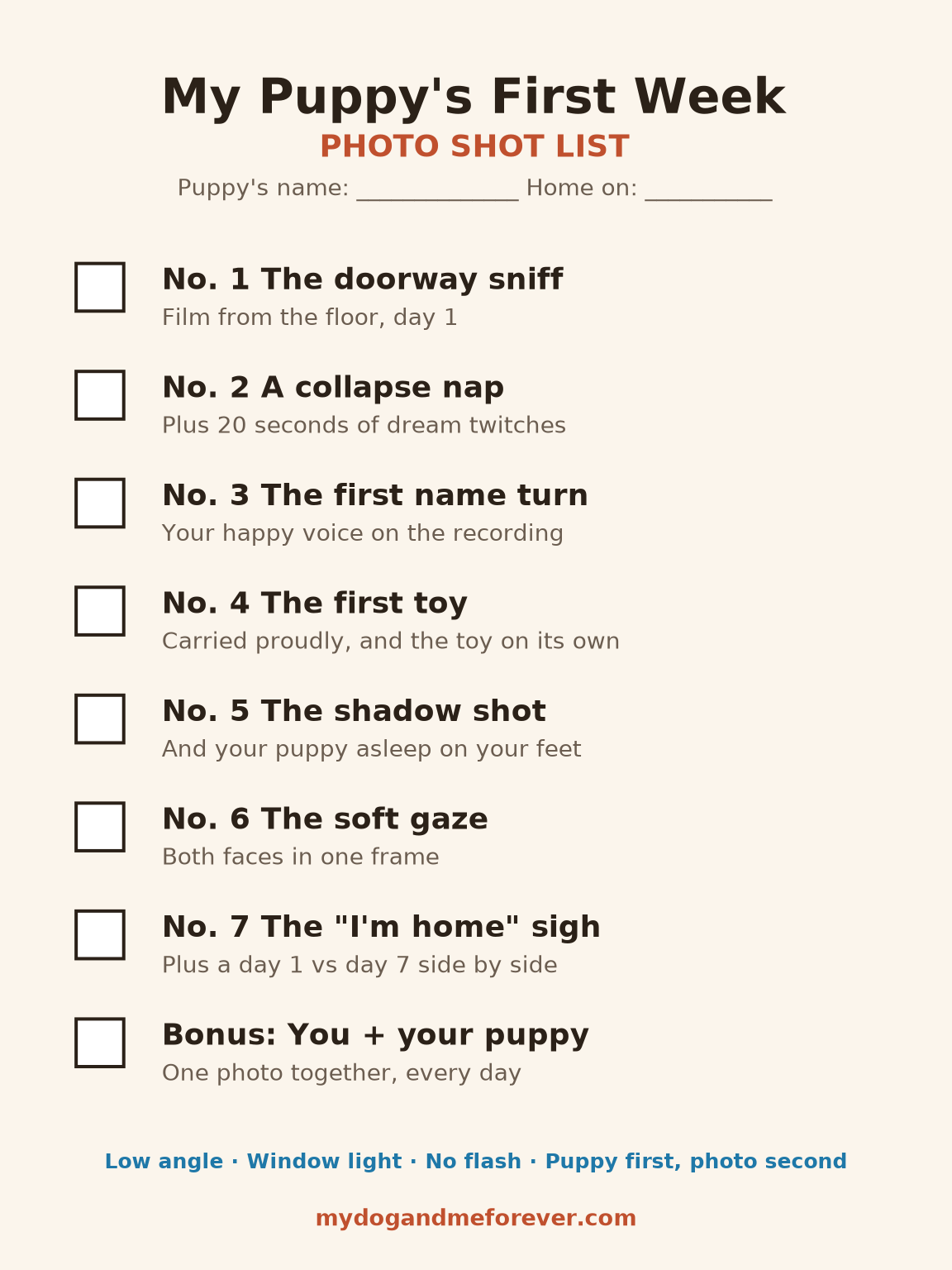
No. 1: The doorway sniff, filmed from the floor
No. 2: A collapse nap, plus 20 seconds of dream twitches
No. 3: The first name turn, with your happy voice on the recording
No. 4: The first toy, carried proudly, and a photo of the toy on its own
No. 5: The shadow shot, and your puppy asleep on your feet
No. 6: The soft gaze, both faces in one frame
No. 7: The "I'm home" sigh, plus a day 1 vs day 7 side-by-side
Bonus: A photo of you and your puppy together, every single day
The Practical Side: What's Normal in a Puppy's First Week
Magic moments are easier to enjoy when you're not worried. Here is what's normal, and what isn't, in the first week with a new puppy.
Crying at night
Very common for the first few nights. Your puppy has never slept away from their littermates. Keep the crate or bed close to you, keep night potty trips boring and quiet, and most puppies settle within a few nights. Our full guide to the first night with your new puppy walks you through it.
Potty trips, all day and some of the night
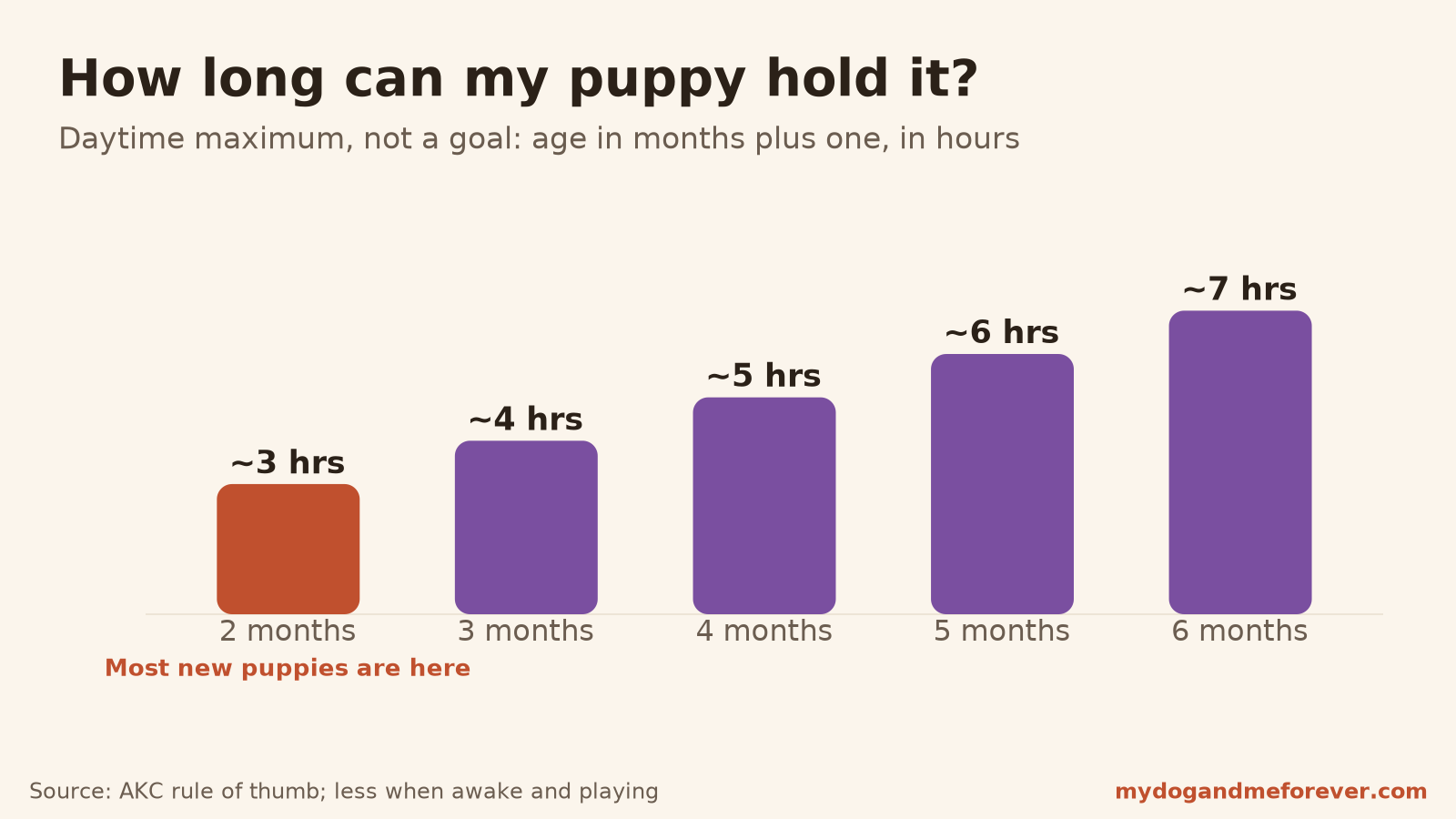
The AKC's rule of thumb is that puppies can hold their bladder for about their age in months plus one, in hours. A 2-month-old puppy can hold it for about 3 hours at most, and less when awake and playing.
Treat that as a maximum, not a goal. Take your puppy out after every nap, every meal, every play session, and first thing in the morning. Praise warmly the moment they go outside. Accidents happen. Clean them up calmly and never scold.
Eating a little less than expected
Many puppies eat less in the first day or two because of stress. Keep feeding the same food they ate before coming home, at the same times, to avoid tummy upsets. If your puppy refuses food for more than a day, or shows vomiting or diarrhea, call your vet.
The first vet visit
According to an AAHA guide citing VCA Animal Hospitals, most puppies should see a vet at 6 to 8 weeks old for their first checkup, vaccines and parasite care, and then every 3 to 4 weeks until they're about 4 to 5 months old.
If your puppy came home without a recent vet check, book one in the first week. Bring any papers from the breeder or shelter, and a stool sample if your vet asks for one. Until your vet says your puppy is protected, avoid places where lots of unknown dogs go, like dog parks.
Few visitors, gentle handling
It's tempting to invite everyone over to meet the puppy. Hold off for a week. Introduce family members calmly, one or two at a time, and let your puppy come to them. Show children how to sit on the floor and let the puppy climb into their lap, rather than picking the puppy up.
When to call your vet the same day
This guide is not a substitute for your vet. Call your vet promptly if your puppy:
Has vomiting or diarrhea, especially with blood
Refuses food or water for more than a day
Seems weak, floppy or unusually hard to wake
Has pale gums, trouble breathing, or a swollen belly
Shows any sign of pain, or you simply feel something is wrong
You know your puppy better than anyone. Trust that feeling.
🐾 Not a substitute for your vet This article is general information to help you enjoy your puppy's first week. It is not a substitute for advice from your own veterinarian, who knows your puppy's health and history. |
What If You Miss a Moment?
You will. Every owner does.
You'll be cleaning up a puddle when the first name turn happens. Your phone will be charging in the kitchen during the best collapse nap of the week. You'll be too busy laughing to film the toy trot.
Here's the secret: these moments don't happen just once. Your puppy will turn to their name a thousand more times. They will follow you through every room of your house for years. That soft gaze will come back on ordinary Tuesday evenings for the rest of their life.
The camera is wonderful. But the real goal isn't a perfect photo album. It's a puppy who feels safe, loved and home.
You're Part of a Very Big Family
If you're feeling a little overwhelmed this week, you are far from alone.
According to the American Pet Products Association's 2026 Dog Report, dog ownership reached 71 million U.S. households in 2025, about 53% of all homes in the country. Every one of those dogs had a first week, too. Somewhere, someone else is mopping a floor at 3 a.m. and smiling about it.
If you haven't brought your puppy home yet, these may help:
And for what comes after week one:
Curious how old your puppy is in human years? Our free Dog Age Calculator shows you in seconds, along with what your puppy needs at this life stage.
Join the My Dog and Me Forever Family
Every week, we share warm, science-backed guides for every stage of your dog's life, from the first night home to the golden years.
When you join our free community, you'll get:
New puppy and dog care guides as soon as they're published
Simple, loving ideas to deepen your bond with your dog
Printable checklists and trackers you can use at home
Frequently Asked Questions
What should I expect in my puppy's first week?
Expect lots of sleep, some crying at night, frequent potty trips and a few accidents. Most puppies are quiet and watchful for the first two or three days, then grow more curious and confident. By the end of the week, many puppies follow you around, know their name and start settling into a routine.
How much should a puppy sleep in the first week?
A lot. According to the AKC, puppies typically need 18 to 20 hours of sleep a day, often in naps of 30 minutes to two hours. Let your puppy sleep and don't wake them for play or photos. If your puppy is very sleepy and also won't eat or seems unwell, call your vet.
Is it normal for a puppy to cry the first week?
Yes. Crying, especially at night, is very common in the first few nights. Your puppy is used to sleeping with their mother and littermates. Keep their bed or crate near you, keep night potty trips calm and quiet, and most puppies settle within a few nights.
Should I take my puppy to the vet in the first week?
Yes, if your puppy hasn't had a recent checkup. Most puppies first see a vet at 6 to 8 weeks old for a checkup, vaccines and parasite care, then every 3 to 4 weeks until about 4 to 5 months. Bring any records from the breeder or shelter to the first visit.
How often should a puppy go potty in the first week?
Take your puppy out after every nap, meal and play session, first thing in the morning and last thing at night. The AKC's rule of thumb is that puppies can hold their bladder for about their age in months plus one, in hours, so a 2-month-old can manage roughly 3 hours at most.
Can I have visitors in my puppy's first week?
Keep visitors to a minimum. Your puppy is adjusting to a whole new world and may be in their first fear period, which the AKC places at around 8 to 11 weeks. Introduce family calmly, one or two people at a time, and let your puppy approach them.
What are the best first-week puppy photos to take?
Aim for the 7 magic moments: the doorway sniff, a collapse nap, the first name turn, the first toy, the first follow, the soft gaze and the end-of-week "I'm home" sigh. Shoot at your puppy's eye level in window light, without a flash, and get in some of the photos yourself.
When will my puppy feel at home?
Every puppy is different. Many trainers use the 3-3-3 rule: about 3 days to decompress, 3 weeks to learn the routine and 3 months to feel fully at home. A confident puppy may settle in days; a shy or rescued puppy may need longer. Patience and routine help most.
Tonight, Before You Go to Sleep
Somewhere in your home right now, there may be a very small puppy curled up in a very new bed.
They don't know what a camera is. They don't know this is their first week. They only know that a few days ago the whole world changed, and that somehow, in the middle of all that change, there is you: your voice, your hands, your smell on the blanket.
Tonight, before you go to sleep, do one small thing. Sit on the floor next to your puppy for five quiet minutes. No phone. No training. Just rest your hand gently near them and let them choose to lean in.
That lean is the beginning of everything.
The photos will remind you of this week for years. But your puppy will remember how it felt.
Welcome home, little one.
Looking for ways to fill the years ahead? Start with our dog bucket list: 20 experiences to share with your dog at least once.
Want these moments to look as magical on your phone as they feel in real life? Here are 11 easy phone tricks for better photos of your dog.
Sources
American Kennel Club (AKC), "Puppy Fear Periods" (socialization period and first fear period)
American Kennel Club (AKC), "How Much Do Puppies Sleep?"
American Kennel Club (AKC), "Why Do Dogs Twitch in Their Sleep?"
American Kennel Club (AKC), "Potty Training Puppy Tips"
American Kennel Club (AKC), "When Does My Puppy Finish Growing?"
American Animal Hospital Association (AAHA), "How Often Should My Dog Go to the Vet? A Dog Life Stage Guide"
Bray, E. E., et al. (2021). "Early-emerging and highly heritable sensitivity to human communication in dogs." Current Biology. University of Arizona news release, "Puppies are wired to communicate with people," June 2021
Ben-Aderet, T., et al. (2017). "Dog-directed speech: why do we use it and do dogs pay attention to it?" Proceedings of the Royal Society B
Nagasawa, M., Kikusui, T., et al. (2015). "Oxytocin-gaze positive loop and the coevolution of human-dog bonds." Science
Kikusui, T., and colleagues (2022). "Increase of tear volume in dogs after reunion with owners is mediated by oxytocin." Current Biology. Cell Press news release, August 2022
American Pet Products Association (APPA), 2026 Dog Report: Strategic Insights from the 2025 National Pet Owners Survey (press release, July 2026)
The White House blog, "Bo's First Day," April 14, 2009; Associated Press and ABC7 Chicago coverage of Bo's arrival, April 14, 2009
CNN coverage of Sunny's introduction to the White House, August 19–20, 2013


Comments