20 Experiences Every Dog Owner Should Share With Their Dog at Least Once


When veterinarian Dr. Jessica Vogelsang learned her dog Kekoa had bone cancer, she did what so many loving owners do. She sat down and wrote a bucket list.
Kayaking. Long walks on the beach. All the grand things she had always meant to do with her dog.
Then she wrote a second list: the things Kekoa actually loved most. It was short. In her words: "Food. Food. Cuddles. Food."
That second list became the real bucket list. They never left the neighborhood. Kekoa tasted one dog-safe treat after another, and a treat company even baked her a special muffin. On her last day, she ate ice cream. By every sign a dog can give, she was very happy.
Hold on to that story, because it's the secret to everything below.
A dog bucket list is a list of experiences you plan to share with your dog while you have them: new smells, new places, small celebrations and quiet moments you'll never forget. The best ones are built around what your dog loves, not what looks good on Instagram. And the best time to start one is now, while your dog is healthy, not after a diagnosis.
Here are 20 experiences every dog owner should share with their dog at least once. Most of them are free. A few will take a weekend. All of them will matter more than you think.
Key takeaways • A dog bucket list works best when it's built around your dog's five favorite things, not your own regrets. • Start while your dog is healthy. The median dog lives about 12.5 years, which is roughly 650 weekends in a whole life. • Dogs live through their noses. Science links sniffing and new smells to a more optimistic dog. • 8 of the 20 experiences below cost nothing at all, most of the rest cost very little, and many work for puppies, seniors and shy dogs alike. • Check with your vet before big physical adventures, new foods or travel, especially for older or flat-faced dogs. • There's a free printable checklist near the end. Tick one off each month. |
Why Every Dog Deserves a Bucket List (and Why It's Really for Both of You)
Most bucket list articles treat the idea as something for the end. A goodbye project.
That's understandable. Many of the dog bucket lists that went viral online were made in a hurry, after terrible news from the vet.
But here's the gentle truth every dog owner eventually learns: our dogs' lives are short, and they are short for everyone, not just for dogs who get sick.
In 2024, researchers at the UK charity Dogs Trust published a huge study of how long dogs live. They looked at 584,734 dogs from more than 150 breeds. The median life expectancy was 12.5 years. Some breeds lived longer (Lancashire Heelers reached a median of 15.4 years). Some lived much shorter lives (French Bulldogs had a median of 9.8 years).
Twelve and a half years sounds like a long time. Until you count it in weekends.

A whole dog life holds about 650 weekends. A dog of five already has about 260 of them behind him. That's not a reason to feel sad. It's a reason to stop saying "one day" and start saying "this Saturday."
That's what a dog bucket list really is. It's a way of saying, out loud: these years matter, and I'm going to fill them on purpose.
And it's good for you too. Your dog's life gets bigger. So does yours. In one UK study of adults over 65, dog owners walked about 22 minutes more per day than people without a dog, at a pace brisk enough to count as real exercise. Adventures with your dog are adventures for your own heart, in every sense.
What Your Dog Actually Wants (It's Not the Grand Canyon)
Before we get to the list, we need to see the world the way a dog does. Otherwise we'll plan a bucket list for ourselves and simply bring the dog along.
Your dog lives through his nose
A dog's nose holds up to 300 million smell receptors. Yours holds about 6 million. A walk you find boring is, to your dog, a newspaper, a group chat and a mystery novel all at once.
That matters more than most owners realize. In a 2019 study, Dr. Charlotte Duranton and Dr. Alexandra Horowitz split 20 pet dogs into two groups. One group practiced nosework, searching for treats with their noses. The other practiced heelwork, walking neatly beside their owner.
Afterwards, the dogs took an "optimism test". The nosework dogs approached an uncertain bowl faster, as if expecting something good. In plain words: letting dogs use their noses made them more optimistic.
So when you plan your dog's bucket list, think in smells first and sights second.
You are the best thing on the list
In a 2015 brain-scan study at Emory University, 12 dogs were trained to lie still in an MRI scanner while they sniffed different scents. The brain's reward center lit up most for one scent: a familiar human from their own household, even more than the scent of a dog they lived with.
Another famous study, published in the journal Science the same year, found that when dogs and their owners gaze at each other, oxytocin (the hormone linked to bonding) rises in both of them. The same didn't happen with hand-raised wolves.
Put those two findings together and you get the most important rule of any dog bucket list: the place matters less than the person. A dog would rather sit in a parking lot with you than visit Paris without you.
If you'd like to go deeper into this science, read our guide to the human-dog bond.
The one rule: plan for him, not for your regrets
Dr. Vogelsang's advice to owners is simple. Ask what your dog would most enjoy, not what you wish they'd tried. A dog who's scared of water doesn't need to go kayaking. A dog who's nervous in crowds doesn't need a big city festival.
That one question changes everything.
How to Build Your Dog's Bucket List in 4 Simple Steps

Step 1: Write down your dog's five favorite things. Be honest and specific. "Rolling in grass." "Cheese." "The neighbour's kids." "Chasing the hose." "Being brushed on the porch."
Step 2: Match each favorite to a bigger version. Loves grass? A wildflower meadow. Loves cheese? A cheese-tasting afternoon with safe, tiny pieces. Loves kids? A family picnic with every child who adores him.
Step 3: Run a safety check. Think about your dog's age, joints, breathing, weather and stress level. Big physical adventures, new foods and long trips are worth a quick word with your vet first.
Step 4: Put one on the calendar every month. A list in a drawer is a wish. A date on the calendar is a plan. Twelve experiences a year is a full, rich year for any dog.
Now let's fill that list.
The Dog Bucket List: 20 Experiences to Share at Least Once
Each experience comes with a quick guide to cost, effort and who it suits, plus what to watch for. Skip anything your dog wouldn't enjoy. Steal anything that makes you smile.

Part 1: The Nose Adventures
No. 1: A "sniffari" where your dog chooses the route
Cost: free · Effort: easy · Good for: every dog, every age
Clip on a long, loose leash and let your dog decide where to go. Left, right, stop for five minutes at one lamp post. You're not walking the dog today. The dog is walking you.
This is the simplest item on the list and maybe the most powerful. It's the closest thing to the nosework that made dogs more optimistic in the Duranton and Horowitz study. And it costs nothing but patience.
Make it special: do it somewhere new, like a different neighborhood or a park across town. New ground means new smells.
Watch for: litter, chicken bones and anything your dog might swallow. Sniffing is wonderful. Snacking on mystery food is not.

No. 2: Paws in the ocean (or a lake, or a river)
Cost: low · Effort: a day out · Good for: dogs who like water or sand
There's something about the first time a dog meets the sea. The waves chase him, he chases them back, and the whole beach smells of salt, fish and adventure.
Find a beach that welcomes dogs and go early in the morning, when the sand is cool and the crowds are thin. If the sea is too far away, a quiet lake shore or a shallow river bank gives your dog the same wild joy.
Watch for: hot sand on paws, too much sun, and your dog gulping seawater. Bring plenty of fresh water and a bowl, and rinse the salt and sand off afterwards.

No. 3: A brand-new trail with a view at the end
Cost: free · Effort: moderate · Good for: healthy, active dogs
Pick a trail you've never walked together and aim for a lookout, a waterfall or a hilltop bench. You get the view. Your dog gets a whole forest of new smells.
Match the trail to your dog, not to your fitness tracker. A short, gentle loop is a perfect hike for a small, young or older dog.
Watch for: ticks, heat, steep drops and wildlife. Check that dogs are allowed, keep him on leash where required, and pack water for both of you.
No. 4: A first snow day (or a giant pile of autumn leaves)
Cost: free · Effort: easy · Good for: most dogs, when the weather allows
If you've ever watched a dog meet snow for the first time, you know. The careful first step. The sniff. And then the explosion of zoomies, face-first dives and pure, silly joy.
No snow where you live? A huge pile of dry autumn leaves, a sprinkler on a hot day, or a ball pit made from a kiddie pool full of plastic balls can bring out the same wild puppy in a dog of any age.
Watch for: cold paws, ice and road salt. Wipe your dog's paws after a snowy walk, and keep small, short-haired and older dogs' outings shorter.
No. 5: A sunrise, side by side
Cost: free · Effort: easy (if you can get up) · Good for: every dog
Set your alarm, take a flask of coffee and walk to the best view near your home before the world wakes up. Sit down. Let your dog lean on you while the sky turns gold.
Your dog won't care about the colors. He'll care that the air smells of fresh dew, that no one else is around, and that he has you all to himself. That's the whole point.
Part 2: The Big Adventures
No. 6: A road trip with the windows cracked
Cost: moderate · Effort: planning needed · Good for: dogs who travel calmly
A real road trip, even just two hours to a new town, is a classic for a reason. New rest stops, new parks, new smells at every gas station. For many dogs, the car itself is the adventure.
Plan stops every couple of hours for a sniff, a stretch and a drink. Pick dog-friendly places to eat outside, and bring your dog's own bed so every new place smells a little like home.
Watch for: heat and loose dogs. The American Veterinary Medical Association warns that a parked car can heat up by almost 20°F (about 11°C) in just 10 minutes, and cracking the windows does very little. Never leave your dog in the car. Use a crash-tested harness or crate, and let him sniff the breeze through a window that's only partly open, not with his whole head out.
No. 7: A night under the stars
Cost: free to moderate · Effort: a weekend · Good for: calm dogs who sleep well near you
Camping with your dog is one of the oldest joys there is. The crackle of the fire. The night sounds. Your dog curled up against your sleeping bag, ears twitching at every owl.
You don't need to drive to a mountain. A tent in the backyard counts. So does a blanket on the lawn on a warm, clear night, with a flashlight, some snacks and the whole sky above you.
Watch for: campsite rules, wildlife, cold nights and an unfamiliar place making a nervous dog anxious. A backyard "test night" first is a smart move.

No. 8: A swim in a quiet lake, with a life jacket
Cost: low · Effort: moderate · Good for: dogs who enjoy water
It's a myth that every dog is a natural swimmer. The American Kennel Club says that, depending on their breed, swimming may come easily to a dog or be a real challenge, and that a life jacket gives a first-time swimmer more confidence.
So make your dog's first proper swim a gentle one. Choose calm, shallow water. Walk in together. Let him decide how far to go. Never throw a dog into water.
Watch for: currents, blue-green algae warnings on lakes, tiredness and shivering. Bring a towel, keep the session short, and stop while it's still fun.
No. 9: A night away in a dog-friendly cabin or hotel
Cost: moderate · Effort: planning needed · Good for: confident, well-settled dogs
Many hotels, cabins and vacation rentals now welcome dogs, and some go all out with beds, bowls and treats at check-in. A weekend away together lets your dog explore new rooms, new walks and a whole new set of smells, then sleep at the foot of a strange bed with his favorite person.
Bring his bed, his food and a favorite toy. Keep the first evening calm while he settles in.
Watch for: a nervous dog left alone in a strange room. Plan your days so he's with you, or choose a stay where that's easy.
No. 10: A taster day at a dog sport
Cost: low to moderate · Effort: a morning · Good for: curious, energetic dogs (and some surprising older ones)
Every dog has a hidden talent waiting to be found. Many training clubs run one-off taster sessions in sports like nosework (scent games), agility (a canine obstacle course), dock diving (long jumps into a pool) or barn hunt (finding hidden scents in straw).
Nosework is a wonderful first choice. It's gentle on joints, suits shy dogs and seniors, and it's exactly the kind of activity linked to a more optimistic dog in the research above.
Watch for: joints and over-excitement. Choose a sport that fits your dog's body, and pick a trainer who uses rewards, not force.
Part 3: The Celebrations
No. 11: A real birthday (or gotcha day) party
Cost: low · Effort: a few hours · Good for: social dogs
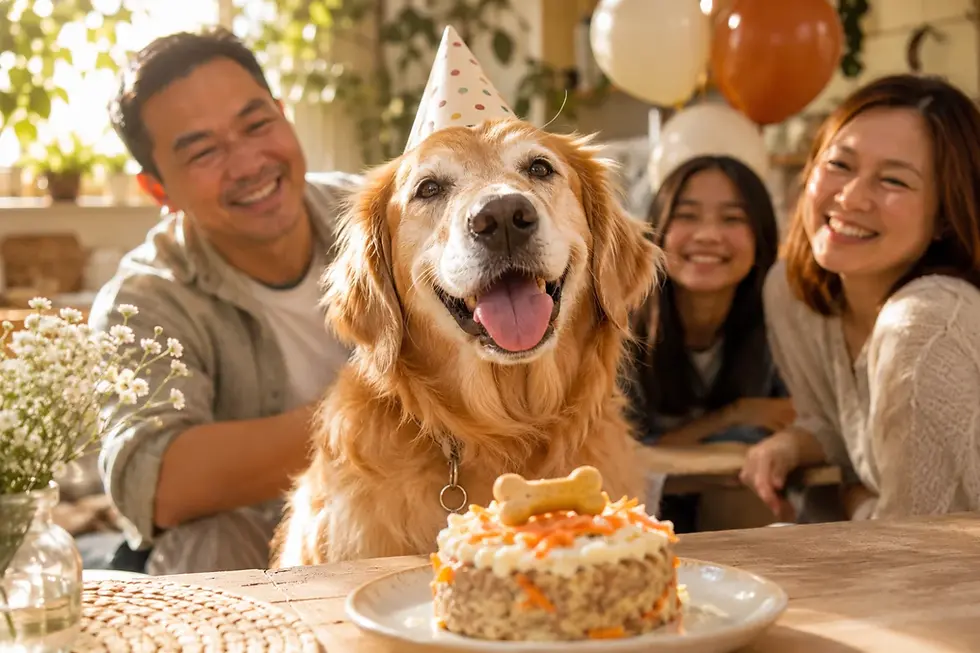
Pick the day, whether it's his real birthday or the day he came home, and throw him a party. Invite the people and dogs he loves most. Bake a dog-safe cake. Sing badly. Take far too many photos.
Don't know your dog's age? Our free dog age calculator shows his real age in human years and which life stage he's in.
Watch for: ingredients. The U.S. Food and Drug Administration warns that xylitol, a sweetener found in some peanut butters, sugar-free desserts and baked goods, can be deadly to dogs. Check every label. Skip chocolate, grapes and raisins entirely, and keep the party small if your dog gets overwhelmed.
No. 12: A "pup cup" on a café patio
Cost: low · Effort: easy · Good for: calm dogs who enjoy people
Find a café with outdoor seating that welcomes dogs. Order your coffee. Order him a tiny cup of plain whipped cream or a dog-safe treat, if the café offers one. Sit in the sun and watch the world go by together.
It's a small thing. But for a dog, sitting beside you in a busy, delicious-smelling new place, with people stopping to say hello, is a big day out.
Watch for: dairy and sweeteners. The ASPCA notes that pets don't make much of the enzyme that digests milk, so dairy can upset their stomachs. Keep it to a lick or two. And never share sugar-free or "skinny" ice cream, which the FDA warns can contain xylitol.
No. 13: A homemade treat baking day
Cost: low · Effort: an afternoon · Good for: every dog with a nose (all of them)
Bake a batch of simple dog biscuits together. Your dog's job is to sit on the kitchen floor, sniff the air and quality-test the results. He will take this job very seriously.
Plain ingredients like oat flour, pumpkin purée, egg and a little xylitol-free peanut butter make easy, safe treats for most dogs. Freeze some to make the day last.
Watch for: allergies and rich food. If your dog has a sensitive tummy, a medical condition or a special diet, ask your vet first.
No. 14: A family portrait with everyone who loves him
Cost: free to moderate · Effort: a morning · Good for: every dog
One day, the photos will matter more than almost anything else you own. So don't wait for a "special" reason. Book a pet photographer, or simply ask a friend to come over at golden hour, the soft hour before sunset.
Gather everyone who loves your dog: family, kids, grandparents, the dog-walker. Take the posed photo. Then take the real ones: the sloppy kiss, the zoomies, the nap on Grandma's lap.
Watch for: a stressed dog. Keep the shoot short, bring treats and take breaks. A relaxed dog takes better photos anyway.
No. 15: A "yes day", when he chooses everything
Cost: free · Effort: a day · Good for: every dog
For one whole day, you say yes. Which way to walk? He decides. Which toy? His pick. Nap at 11 a.m.? Absolutely. A longer sniff at the interesting tree? As long as he likes.
Of course, "yes" still means safe. But giving your dog real choices for a day is a gift most dogs rarely get. In the nosework study above, the researchers named behaving naturally and making active choices as two key parts of a good life for an animal. A yes day gives your dog plenty of both.
Part 4: The Quiet Ones That Mean the Most
No. 16: Learn one new trick together
Cost: free · Effort: 5 minutes a day · Good for: every age, including old dogs
Pick one trick and work on it for five minutes a day. A paw shake. A spin. A bow. "Find it." For older dogs, a gentle chin rest or a nose touch to your hand.
The trick itself doesn't matter. What matters is those few minutes a day of teamwork, treats and praise. Your dog learns that you two can figure things out together.
If you're starting with a puppy, our guide to a simple puppy routine shows how to fit tiny training games into every day.
No. 17: Do some good together
Cost: free to low · Effort: varies · Good for: friendly, calm dogs
Join a charity dog walk or a fun run for a local animal shelter. If your dog is gentle and loves strangers, look into therapy dog programs that visit care homes, hospitals or school reading groups.
There's a special kind of pride in watching your dog make a stranger smile. And it gives the two of you something to be proud of together.
Watch for: stress. Not every lovely dog enjoys busy places full of strangers, and that's okay. Choose the kind of "good" that suits your dog's personality.
No. 18: Make a keepsake of his paw print
Cost: low · Effort: easy · Good for: every dog
Press his paw into a little air-dry clay or salt dough, or make a paint print on card using pet-safe, non-toxic paint. Write the date and his age beside it.
It takes ten minutes. Years from now, it will be one of the most precious things you own.
Watch for: paint and clay ingredients. Use pet-safe products, and wipe his paw clean straight away so he doesn't lick any off.
No. 19: A whole lazy afternoon of napping together
Cost: free · Effort: none at all · Good for: every dog (especially the ones who are getting older)
Remember Kekoa's list? Food. Food. Cuddles. Food.
Clear a whole afternoon. No phone. No chores. Lie down on the sofa or a blanket in a sunny spot and let your dog curl up against you. Listen to his breathing slow down. Feel his weight settle. Drift off together.
It may sound too simple to be on a bucket list. But ask yourself: when did you last do it? To your dog, your scent and your closeness are the best reward there is. The brain scans back that up.

No. 20: Film one ordinary day in his life
Cost: free · Effort: easy · Good for: every dog
Not the tricks. Not the birthday. The ordinary stuff. The way he stretches when he wakes up. The noise he makes when you pick up the leash. The spot where he waits for you by the door. The little sigh before he falls asleep.
Film a few seconds of each, all through one normal day. Then write down three of his funny habits in a notebook or on your phone.
You think you'll always remember these things. Every owner who has lost a dog will tell you the same thing: the ordinary moments are the ones you'll miss most, and the ones you'll wish you had on film.
Don't Wait for a Diagnosis
In 2015, a young writer in New York named Lauren Fern Watt got the call every dog owner dreads. Her 160-pound English Mastiff, Gizelle, had bone cancer. Her vet thought they might have only a few months.
So Lauren made a bucket list, and they went for it. A canoe ride, which nervous Gizelle wasn't sure about. Times Square. A road trip. Lobster in Maine. A search for the best doughnut in the world. Plain vanilla ice cream. Gizelle even got to see snow on the beach.
Their story touched people around the world. Lauren's memoir, Gizelle's Bucket List, was published by Simon & Schuster in 2017 and has been translated into eleven languages.
It's a beautiful story. But notice when it started: after the diagnosis.
Dr. Vogelsang, who has lived both sides of this as a vet and an owner, puts it plainly. The best time to live out a grand bucket list is before your dog gets ill, while they are still healthy.
Sick dogs often don't feel up to big adventures. Pain, nausea and tiredness all shrink the list. When her other dog, Emmett, was ill with lymphoma, his "bucket list" trip was a gentle one: a short visit to his favorite place, Dog Beach. They sat on the sand for 20 minutes, watching other dogs play in the waves. He died two days later.
Twenty minutes on the sand was perfect for Emmett. But imagine all the beach mornings that could have come before it.
This is why your dog's bucket list starts today, whatever his age. If he's a puppy, you have years of firsts ahead, starting with the magic moments of his first week. If he's in his prime, these are his best adventure years. And if his muzzle is going grey, choose the gentler experiences and make every one of them count. Our senior dog care guide can help you keep those golden years comfortable.
How happy is your dog's life right now? Before you plan the big adventures, take a quiet look at the everyday ones. Our gentle 2-minute quality of life quiz walks you through seven simple questions about your dog's comfort, appetite, mobility and happiness, so you can see what to add more of and what to talk to your vet about. You'll get a clear picture of how your dog is really doing, plus a free 30-day tracker to spot good and bad days early. |
When to Check With Your Vet First
Most of the experiences above are gentle and safe for healthy dogs. But a quick call to your vet is a good idea before you:
Start a new physical activity, like a long hike, a swim or a dog sport, especially with a puppy, an older dog or a heavy breed
Plan a trip in hot weather with a flat-faced breed like a Pug, French Bulldog or Boxer, since these dogs struggle more in heat
Try new foods or treats, especially if your dog has a sensitive stomach, allergies or a medical condition
Travel a long way, cross borders or fly, which can need vaccines, paperwork or calming plans
Plan any adventure for a dog who is unwell, in pain or on medication
This article is for general information and isn't a substitute for advice from your own vet, who knows your dog best.
Your Free Printable Dog Bucket List Checklist
Print this, stick it on the fridge, and tick one off every month. Write the date beside each one. In a year, you'll have a page full of memories.

Your dog's bucket list at a glance:
☐ No. 1: A sniffari where your dog chooses the route
☐ No. 2: Paws in the ocean, a lake or a river
☐ No. 3: A brand-new trail with a view
☐ No. 4: A first snow day (or a giant leaf pile)
☐ No. 5: A sunrise, side by side
☐ No. 6: A road trip with the windows cracked
☐ No. 7: A night under the stars
☐ No. 8: A swim in a quiet lake, with a life jacket
☐ No. 9: A night away in a dog-friendly cabin or hotel
☐ No. 10: A taster day at a dog sport
☐ No. 11: A birthday or gotcha day party
☐ No. 12: A pup cup on a café patio
☐ No. 13: A homemade treat baking day
☐ No. 14: A family portrait with everyone who loves him
☐ No. 15: A yes day, when he chooses everything
☐ No. 16: Learn one new trick together
☐ No. 17: Do some good together
☐ No. 18: A paw print keepsake
☐ No. 19: A lazy afternoon of napping together
☐ No. 20: Film one ordinary day in his life
Just brought a dog home? Our guide to the first day with a new dog will help you start your story the right way, and our first-time dog owner tips cover the things nobody warns you about.
Frequently Asked Questions About a Dog Bucket List
What is a dog bucket list?
A dog bucket list is a list of experiences you plan to share with your dog during their life, such as a beach day, a road trip, a birthday party or a long sniff walk somewhere new. The best lists are built around what your dog loves most, and they work for dogs of every age, not only for dogs who are old or ill.
What should I put on my dog's bucket list?
Start with your dog's five favorite things, then plan bigger versions of them. A dog who loves sniffing might enjoy a new trail or a nosework class. A food-loving dog might enjoy a baking day. Add a few quiet moments too, like a sunrise or an afternoon nap together. Skip anything that would scare or stress your dog.
When should I start a bucket list for my dog?
Start now, whatever your dog's age. Veterinarian Dr. Jessica Vogelsang points out that the best time for big adventures is while a dog is healthy, because sick dogs often feel too unwell for travel or activity. Puppies can enjoy gentle firsts, adult dogs can handle bigger trips, and senior dogs can enjoy calmer, slower experiences.
What are good bucket list ideas for an older dog?
Choose gentle experiences that suit stiff joints and lower energy: a slow sniff walk somewhere new, a short visit to a favorite place, a car ride with the window partly down, a family photo shoot, a paw print keepsake, a favorite safe treat, or a long nap together in the sun. Ask your vet before anything physical or any new food.
How many items should be on a dog bucket list?
There's no right number. Many owners like 10 to 20 items, so there's variety without pressure. A good rhythm is one experience a month, which gives you 12 shared adventures a year. A short list you actually do is far better than a long list you never start.
Do dogs really enjoy new experiences?
Many do, especially experiences full of new smells. In one study, dogs who practiced nosework became more optimistic than dogs who practiced walking to heel. But every dog is different. Shy or anxious dogs may prefer quiet, familiar places. Watch your dog's body language and let their comfort guide the list.
Is a bucket list a good idea for a dog who is terminally ill?
It can be, if it's planned around how your dog feels. Keep experiences short, calm and close to home, avoid rich foods that could upset a sick stomach, and ask your vet before travel or special treats. Often the simplest things, like favorite foods, cuddles and a familiar view, mean the most.
Tonight: One Small Thing to Do With Your Dog
You don't need a beach or a cabin to begin. You can tick off the first item tonight.
After dinner, clip on the leash and step outside. But this time, don't lead.
Let your dog choose the way. Let him stop at the gatepost for as long as he likes. Let him read the night: the cat that passed by an hour ago, the neighbour's barbecue, the rain on the grass.
Stand there under the streetlight and wait for him. There's no rush. There's nowhere else you need to be.
At some point he'll look back over his shoulder to check you're still there.
When he does, look back at him. Hold it for a moment.
That's it. That's the whole first item on the list. It took twenty minutes and cost nothing, and for your dog it may well have been the best walk of the week.
Nineteen more to go. Make them count.
Join the My Dog and Me Forever community Get new articles on building a long, happy life with your dog, from day one to the golden years, delivered to your inbox. |
Every experience on this list deserves a photo you'll treasure. Here are 11 easy phone tricks for better photos of your dog.
Want to make moments like these happen every year? Read How to Start a Dog Tradition Your Whole Family Will Look Forward to Every Year.
Many of these adventures start with a long drive. Before you set off, read our road trip with your dog checklist.
Keep reading:
Sources
McMillan, K.M., Bielby, J., Williams, C.L. et al. (2024). Longevity of companion dog breeds: those at risk from early death. Scientific Reports 14, 531. https://www.nature.com/articles/s41598-023-50458-w
Duranton, C. and Horowitz, A. (2019). Let me sniff! Nosework induces positive judgment bias in pet dogs. Applied Animal Behaviour Science 211, 61–66. https://doi.org/10.1016/j.applanim.2018.12.009
Berns, G.S., Brooks, A.M. and Spivak, M. (2015). Scent of the familiar: an fMRI study of canine brain responses to familiar and unfamiliar human and dog odors. Behavioural Processes 110, 37–46. https://pubmed.ncbi.nlm.nih.gov/24607363/
Nagasawa, M. et al. (2015). Oxytocin-gaze positive loop and the coevolution of human-dog bonds. Science 348, 333–336. https://doi.org/10.1126/science.1261022
Dall, P.M. et al. (2017). The influence of dog ownership on objective measures of free-living physical activity and sedentary behaviour in community-dwelling older adults. BMC Public Health. https://doi.org/10.1186/s12889-017-4422-5
PBS NOVA. 6 stinking cool facts about dog noses. https://www.pbs.org/wgbh/nova/article/dog-smell-olfaction-nose
Vogelsang, J., DVM. Doggy Bucket Lists: Pros, Cons, Do's and Don'ts. Vetstreet. https://www.vetstreet.com/our-pet-experts/doggy-bucket-lists-pros-cons-dos-and-donts
American Veterinary Medical Association. Pets in vehicles. https://www.avma.org/resources-tools/pet-owners/petcare/pets-vehicles
American Kennel Club. Dog swimming safety. https://www.akc.org/expert-advice/health/dog-swimming-safety/
U.S. Food and Drug Administration. Paws Off Xylitol; It's Dangerous for Dogs. https://www.fda.gov/consumers/consumer-updates/paws-xylitol-its-dangerous-dogs
ASPCA Animal Poison Control. People Foods to Avoid Feeding Your Pets. https://www.aspca.org/pet-care/aspca-poison-control/people-foods-avoid-feeding-your-pets
New York Post (2017). Ultimate dog treat (on Lauren Fern Watt and Gizelle), via PressReader. https://www.pressreader.com/usa/new-york-post/20170305/281938837705618
American Kennel Club. Dying dog gets to experience life's greatest pleasures. https://www.akc.org/expert-advice/news/dying-dog-gets-to-experience-lifes-greatest-pleasures/
Everand. Gizelle's Bucket List: My Life with a Very Large Dog (book listing). https://www.everand.com/book/339448357/Gizelle-s-Bucket-List-My-Life-with-a-Very-Large-Dog
Kirkus Reviews. Gizelle's Bucket List: My Life with a Very Large Dog by Lauren Fern Watt (Simon & Schuster, 2017). https://kirkusreviews.com/book-reviews/lauren-fern-watt/gizelles-bucket-list/print

Comments